

1.4: The Transformation Process
- Page ID
- 115641
\( \newcommand{\vecs}[1]{\overset { \scriptstyle \rightharpoonup} {\mathbf{#1}} } \)
\( \newcommand{\vecd}[1]{\overset{-\!-\!\rightharpoonup}{\vphantom{a}\smash {#1}}} \)
\( \newcommand{\dsum}{\displaystyle\sum\limits} \)
\( \newcommand{\dint}{\displaystyle\int\limits} \)
\( \newcommand{\dlim}{\displaystyle\lim\limits} \)
\( \newcommand{\id}{\mathrm{id}}\) \( \newcommand{\Span}{\mathrm{span}}\)
( \newcommand{\kernel}{\mathrm{null}\,}\) \( \newcommand{\range}{\mathrm{range}\,}\)
\( \newcommand{\RealPart}{\mathrm{Re}}\) \( \newcommand{\ImaginaryPart}{\mathrm{Im}}\)
\( \newcommand{\Argument}{\mathrm{Arg}}\) \( \newcommand{\norm}[1]{\| #1 \|}\)
\( \newcommand{\inner}[2]{\langle #1, #2 \rangle}\)
\( \newcommand{\Span}{\mathrm{span}}\)
\( \newcommand{\id}{\mathrm{id}}\)
\( \newcommand{\Span}{\mathrm{span}}\)
\( \newcommand{\kernel}{\mathrm{null}\,}\)
\( \newcommand{\range}{\mathrm{range}\,}\)
\( \newcommand{\RealPart}{\mathrm{Re}}\)
\( \newcommand{\ImaginaryPart}{\mathrm{Im}}\)
\( \newcommand{\Argument}{\mathrm{Arg}}\)
\( \newcommand{\norm}[1]{\| #1 \|}\)
\( \newcommand{\inner}[2]{\langle #1, #2 \rangle}\)
\( \newcommand{\Span}{\mathrm{span}}\) \( \newcommand{\AA}{\unicode[.8,0]{x212B}}\)
\( \newcommand{\vectorA}[1]{\vec{#1}} % arrow\)
\( \newcommand{\vectorAt}[1]{\vec{\text{#1}}} % arrow\)
\( \newcommand{\vectorB}[1]{\overset { \scriptstyle \rightharpoonup} {\mathbf{#1}} } \)
\( \newcommand{\vectorC}[1]{\textbf{#1}} \)
\( \newcommand{\vectorD}[1]{\overrightarrow{#1}} \)
\( \newcommand{\vectorDt}[1]{\overrightarrow{\text{#1}}} \)
\( \newcommand{\vectE}[1]{\overset{-\!-\!\rightharpoonup}{\vphantom{a}\smash{\mathbf {#1}}}} \)
\( \newcommand{\vecs}[1]{\overset { \scriptstyle \rightharpoonup} {\mathbf{#1}} } \)
\(\newcommand{\longvect}{\overrightarrow}\)
\( \newcommand{\vecd}[1]{\overset{-\!-\!\rightharpoonup}{\vphantom{a}\smash {#1}}} \)
\(\newcommand{\avec}{\mathbf a}\) \(\newcommand{\bvec}{\mathbf b}\) \(\newcommand{\cvec}{\mathbf c}\) \(\newcommand{\dvec}{\mathbf d}\) \(\newcommand{\dtil}{\widetilde{\mathbf d}}\) \(\newcommand{\evec}{\mathbf e}\) \(\newcommand{\fvec}{\mathbf f}\) \(\newcommand{\nvec}{\mathbf n}\) \(\newcommand{\pvec}{\mathbf p}\) \(\newcommand{\qvec}{\mathbf q}\) \(\newcommand{\svec}{\mathbf s}\) \(\newcommand{\tvec}{\mathbf t}\) \(\newcommand{\uvec}{\mathbf u}\) \(\newcommand{\vvec}{\mathbf v}\) \(\newcommand{\wvec}{\mathbf w}\) \(\newcommand{\xvec}{\mathbf x}\) \(\newcommand{\yvec}{\mathbf y}\) \(\newcommand{\zvec}{\mathbf z}\) \(\newcommand{\rvec}{\mathbf r}\) \(\newcommand{\mvec}{\mathbf m}\) \(\newcommand{\zerovec}{\mathbf 0}\) \(\newcommand{\onevec}{\mathbf 1}\) \(\newcommand{\real}{\mathbb R}\) \(\newcommand{\twovec}[2]{\left[\begin{array}{r}#1 \\ #2 \end{array}\right]}\) \(\newcommand{\ctwovec}[2]{\left[\begin{array}{c}#1 \\ #2 \end{array}\right]}\) \(\newcommand{\threevec}[3]{\left[\begin{array}{r}#1 \\ #2 \\ #3 \end{array}\right]}\) \(\newcommand{\cthreevec}[3]{\left[\begin{array}{c}#1 \\ #2 \\ #3 \end{array}\right]}\) \(\newcommand{\fourvec}[4]{\left[\begin{array}{r}#1 \\ #2 \\ #3 \\ #4 \end{array}\right]}\) \(\newcommand{\cfourvec}[4]{\left[\begin{array}{c}#1 \\ #2 \\ #3 \\ #4 \end{array}\right]}\) \(\newcommand{\fivevec}[5]{\left[\begin{array}{r}#1 \\ #2 \\ #3 \\ #4 \\ #5 \\ \end{array}\right]}\) \(\newcommand{\cfivevec}[5]{\left[\begin{array}{c}#1 \\ #2 \\ #3 \\ #4 \\ #5 \\ \end{array}\right]}\) \(\newcommand{\mattwo}[4]{\left[\begin{array}{rr}#1 \amp #2 \\ #3 \amp #4 \\ \end{array}\right]}\) \(\newcommand{\laspan}[1]{\text{Span}\{#1\}}\) \(\newcommand{\bcal}{\cal B}\) \(\newcommand{\ccal}{\cal C}\) \(\newcommand{\scal}{\cal S}\) \(\newcommand{\wcal}{\cal W}\) \(\newcommand{\ecal}{\cal E}\) \(\newcommand{\coords}[2]{\left\{#1\right\}_{#2}}\) \(\newcommand{\gray}[1]{\color{gray}{#1}}\) \(\newcommand{\lgray}[1]{\color{lightgray}{#1}}\) \(\newcommand{\rank}{\operatorname{rank}}\) \(\newcommand{\row}{\text{Row}}\) \(\newcommand{\col}{\text{Col}}\) \(\renewcommand{\row}{\text{Row}}\) \(\newcommand{\nul}{\text{Nul}}\) \(\newcommand{\var}{\text{Var}}\) \(\newcommand{\corr}{\text{corr}}\) \(\newcommand{\len}[1]{\left|#1\right|}\) \(\newcommand{\bbar}{\overline{\bvec}}\) \(\newcommand{\bhat}{\widehat{\bvec}}\) \(\newcommand{\bperp}{\bvec^\perp}\) \(\newcommand{\xhat}{\widehat{\xvec}}\) \(\newcommand{\vhat}{\widehat{\vvec}}\) \(\newcommand{\uhat}{\widehat{\uvec}}\) \(\newcommand{\what}{\widehat{\wvec}}\) \(\newcommand{\Sighat}{\widehat{\Sigma}}\) \(\newcommand{\lt}{<}\) \(\newcommand{\gt}{>}\) \(\newcommand{\amp}{&}\) \(\definecolor{fillinmathshade}{gray}{0.9}\)Transformation Processes
A transformation process is any activity or group of activities that takes one or more inputs, transforms and adds value to them, and provides outputs for customers or clients. Where the inputs are raw materials, it is relatively easy to identify the transformation involved, such as when milk is transformed into cheese or butter. Where the inputs are information or people, the nature of the transformation may be less obvious. For example, a hospital transforms ill patients (the input) into healthy patients (the output).
Examples of Transformation Processes:
· changes in the physical characteristics of materials or customers
· changes in the location of materials, information or customers
· changes in the ownership of materials or information
· storage or accommodation of materials, information or customers
· changes in the purpose or form of information
· changes in the physiological or psychological state of customers
Often all three types of input – materials, information and customers – must be transformed by a single organization. For example, withdrawing money from a bank account involves information about the customer’s account, materials (such as checks and currency), and the customer. Treating a patient in hospital involves not only the “customer’s” state of health, but also any materials used in treatment, as well as information about the patient.
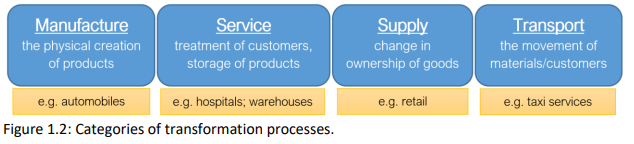
As Figure 1.2 demonstrates, transformation processes can be categorized into four groups: manufacture (the physical creation of products, e.g. automobiles), service (the treatment of customers or storage of products, e.g. hospitals or warehouses), supply (a change in ownership of goods, e.g. retail), and transport (the movement of materials or customers, e.g. taxi service).
Several different transformations are usually required to produce a good or service. The overall transformation can be described as the macro operation, and the more detailed transformations within this macro operation as micro operations. For example, the macro operation in a brewery is making beer (Figure 1.3). The micro operations include:
- milling the malted barley into grist
- mixing the grist with hot water to form wort
- cooling the wort and transferring it to the fermentation vessel
- adding yeast to the wort and fermenting the liquid into beer
- filtering the beer to remove the spent yeast
- decanting the beer into casks or bottles.

Producing Goods and Services
The production and goods, and the performance of services are both part of operations management. There are however some key differences in the two.
In the production of goods the result is the creation of a tangible product such as a vehicle, an article of clothing, a cell phone or a shovel. A service on the other hand is an intangible such as a car repair, a haircut, or a medical treatment. There are some key differences in managing these two types of businesses.
- Services have a much higher amount of customer contact. The customer will generally come to the service provider for the service to take place, or the service provider will come to the customer.
- In manufacturing the customer rarely comes to our facility. The purchase generally takes place at a different location than the one where the manufacturing occurred. That simplifies matters quite a bit.
- Services have a higher amount of labor content than manufacturing organizations.
- Services have a much higher degree of input variability than do manufacturing companies. Each customer often arrives to a service with a unique set of circumstances that may require extra time and skills on the part of the service provider.
- Measurement of quality is much more straight-forward in a manufacturing setting. There are many technical ways of deciding if manufactured goods have the required quality level.
- In services many factors will affect the customers impression of the quality of the service received.
- Measurement of productivity is very straight-forward in a manufacturing operation due to high degree of standardization in the inputs and outputs used.
- In services it is more difficult to measure productivity.
- Inventory can be stored in the case of a manufacturing organization. If goods are not sold in the intended week, then they can be put into storage to be sold at a later date.
- In services, once the time period has passed, the opportunity to use that capacity is gone.
Source: "Introduction to Operations Management(opens in new window)," Inroduction to Operations Management Copyright © by Hamid Faramarzi and Mary Drane is licensed under a Creative Commons Attribution-NonCommercial-ShareAlike 4.0 International License, except where otherwise noted.
The following 7:04 video illustrates the transformation process for both goods and services:
As you watch the video, pay close attention to how goods and services are differentiated.