

7: Performance Management and Continuous Improvement
- Page ID
- 157567

\( \newcommand{\vecs}[1]{\overset { \scriptstyle \rightharpoonup} {\mathbf{#1}} } \)
\( \newcommand{\vecd}[1]{\overset{-\!-\!\rightharpoonup}{\vphantom{a}\smash {#1}}} \)
\( \newcommand{\dsum}{\displaystyle\sum\limits} \)
\( \newcommand{\dint}{\displaystyle\int\limits} \)
\( \newcommand{\dlim}{\displaystyle\lim\limits} \)
\( \newcommand{\id}{\mathrm{id}}\) \( \newcommand{\Span}{\mathrm{span}}\)
( \newcommand{\kernel}{\mathrm{null}\,}\) \( \newcommand{\range}{\mathrm{range}\,}\)
\( \newcommand{\RealPart}{\mathrm{Re}}\) \( \newcommand{\ImaginaryPart}{\mathrm{Im}}\)
\( \newcommand{\Argument}{\mathrm{Arg}}\) \( \newcommand{\norm}[1]{\| #1 \|}\)
\( \newcommand{\inner}[2]{\langle #1, #2 \rangle}\)
\( \newcommand{\Span}{\mathrm{span}}\)
\( \newcommand{\id}{\mathrm{id}}\)
\( \newcommand{\Span}{\mathrm{span}}\)
\( \newcommand{\kernel}{\mathrm{null}\,}\)
\( \newcommand{\range}{\mathrm{range}\,}\)
\( \newcommand{\RealPart}{\mathrm{Re}}\)
\( \newcommand{\ImaginaryPart}{\mathrm{Im}}\)
\( \newcommand{\Argument}{\mathrm{Arg}}\)
\( \newcommand{\norm}[1]{\| #1 \|}\)
\( \newcommand{\inner}[2]{\langle #1, #2 \rangle}\)
\( \newcommand{\Span}{\mathrm{span}}\) \( \newcommand{\AA}{\unicode[.8,0]{x212B}}\)
\( \newcommand{\vectorA}[1]{\vec{#1}} % arrow\)
\( \newcommand{\vectorAt}[1]{\vec{\text{#1}}} % arrow\)
\( \newcommand{\vectorB}[1]{\overset { \scriptstyle \rightharpoonup} {\mathbf{#1}} } \)
\( \newcommand{\vectorC}[1]{\textbf{#1}} \)
\( \newcommand{\vectorD}[1]{\overrightarrow{#1}} \)
\( \newcommand{\vectorDt}[1]{\overrightarrow{\text{#1}}} \)
\( \newcommand{\vectE}[1]{\overset{-\!-\!\rightharpoonup}{\vphantom{a}\smash{\mathbf {#1}}}} \)
\( \newcommand{\vecs}[1]{\overset { \scriptstyle \rightharpoonup} {\mathbf{#1}} } \)
\(\newcommand{\longvect}{\overrightarrow}\)
\( \newcommand{\vecd}[1]{\overset{-\!-\!\rightharpoonup}{\vphantom{a}\smash {#1}}} \)
\(\newcommand{\avec}{\mathbf a}\) \(\newcommand{\bvec}{\mathbf b}\) \(\newcommand{\cvec}{\mathbf c}\) \(\newcommand{\dvec}{\mathbf d}\) \(\newcommand{\dtil}{\widetilde{\mathbf d}}\) \(\newcommand{\evec}{\mathbf e}\) \(\newcommand{\fvec}{\mathbf f}\) \(\newcommand{\nvec}{\mathbf n}\) \(\newcommand{\pvec}{\mathbf p}\) \(\newcommand{\qvec}{\mathbf q}\) \(\newcommand{\svec}{\mathbf s}\) \(\newcommand{\tvec}{\mathbf t}\) \(\newcommand{\uvec}{\mathbf u}\) \(\newcommand{\vvec}{\mathbf v}\) \(\newcommand{\wvec}{\mathbf w}\) \(\newcommand{\xvec}{\mathbf x}\) \(\newcommand{\yvec}{\mathbf y}\) \(\newcommand{\zvec}{\mathbf z}\) \(\newcommand{\rvec}{\mathbf r}\) \(\newcommand{\mvec}{\mathbf m}\) \(\newcommand{\zerovec}{\mathbf 0}\) \(\newcommand{\onevec}{\mathbf 1}\) \(\newcommand{\real}{\mathbb R}\) \(\newcommand{\twovec}[2]{\left[\begin{array}{r}#1 \\ #2 \end{array}\right]}\) \(\newcommand{\ctwovec}[2]{\left[\begin{array}{c}#1 \\ #2 \end{array}\right]}\) \(\newcommand{\threevec}[3]{\left[\begin{array}{r}#1 \\ #2 \\ #3 \end{array}\right]}\) \(\newcommand{\cthreevec}[3]{\left[\begin{array}{c}#1 \\ #2 \\ #3 \end{array}\right]}\) \(\newcommand{\fourvec}[4]{\left[\begin{array}{r}#1 \\ #2 \\ #3 \\ #4 \end{array}\right]}\) \(\newcommand{\cfourvec}[4]{\left[\begin{array}{c}#1 \\ #2 \\ #3 \\ #4 \end{array}\right]}\) \(\newcommand{\fivevec}[5]{\left[\begin{array}{r}#1 \\ #2 \\ #3 \\ #4 \\ #5 \\ \end{array}\right]}\) \(\newcommand{\cfivevec}[5]{\left[\begin{array}{c}#1 \\ #2 \\ #3 \\ #4 \\ #5 \\ \end{array}\right]}\) \(\newcommand{\mattwo}[4]{\left[\begin{array}{rr}#1 \amp #2 \\ #3 \amp #4 \\ \end{array}\right]}\) \(\newcommand{\laspan}[1]{\text{Span}\{#1\}}\) \(\newcommand{\bcal}{\cal B}\) \(\newcommand{\ccal}{\cal C}\) \(\newcommand{\scal}{\cal S}\) \(\newcommand{\wcal}{\cal W}\) \(\newcommand{\ecal}{\cal E}\) \(\newcommand{\coords}[2]{\left\{#1\right\}_{#2}}\) \(\newcommand{\gray}[1]{\color{gray}{#1}}\) \(\newcommand{\lgray}[1]{\color{lightgray}{#1}}\) \(\newcommand{\rank}{\operatorname{rank}}\) \(\newcommand{\row}{\text{Row}}\) \(\newcommand{\col}{\text{Col}}\) \(\renewcommand{\row}{\text{Row}}\) \(\newcommand{\nul}{\text{Nul}}\) \(\newcommand{\var}{\text{Var}}\) \(\newcommand{\corr}{\text{corr}}\) \(\newcommand{\len}[1]{\left|#1\right|}\) \(\newcommand{\bbar}{\overline{\bvec}}\) \(\newcommand{\bhat}{\widehat{\bvec}}\) \(\newcommand{\bperp}{\bvec^\perp}\) \(\newcommand{\xhat}{\widehat{\xvec}}\) \(\newcommand{\vhat}{\widehat{\vvec}}\) \(\newcommand{\uhat}{\widehat{\uvec}}\) \(\newcommand{\what}{\widehat{\wvec}}\) \(\newcommand{\Sighat}{\widehat{\Sigma}}\) \(\newcommand{\lt}{<}\) \(\newcommand{\gt}{>}\) \(\newcommand{\amp}{&}\) \(\definecolor{fillinmathshade}{gray}{0.9}\)- Define performance management and explain its purpose in organizations.
- Identify and describe the key elements of a performance management system, including goal setting, feedback, and performance evaluation.
- Explain how individual performance aligns with organizational goals and contributes to overall success.
- Recognize common challenges organizations face when managing employee performance.
- Analyze the impact of feedback and communication on employee motivation and improvement.
- Describe how performance management practices have evolved from traditional evaluations to modern, continuous approaches.
- Explain the role of technology and ongoing development in current performance management systems.
Introduction to Performance Management
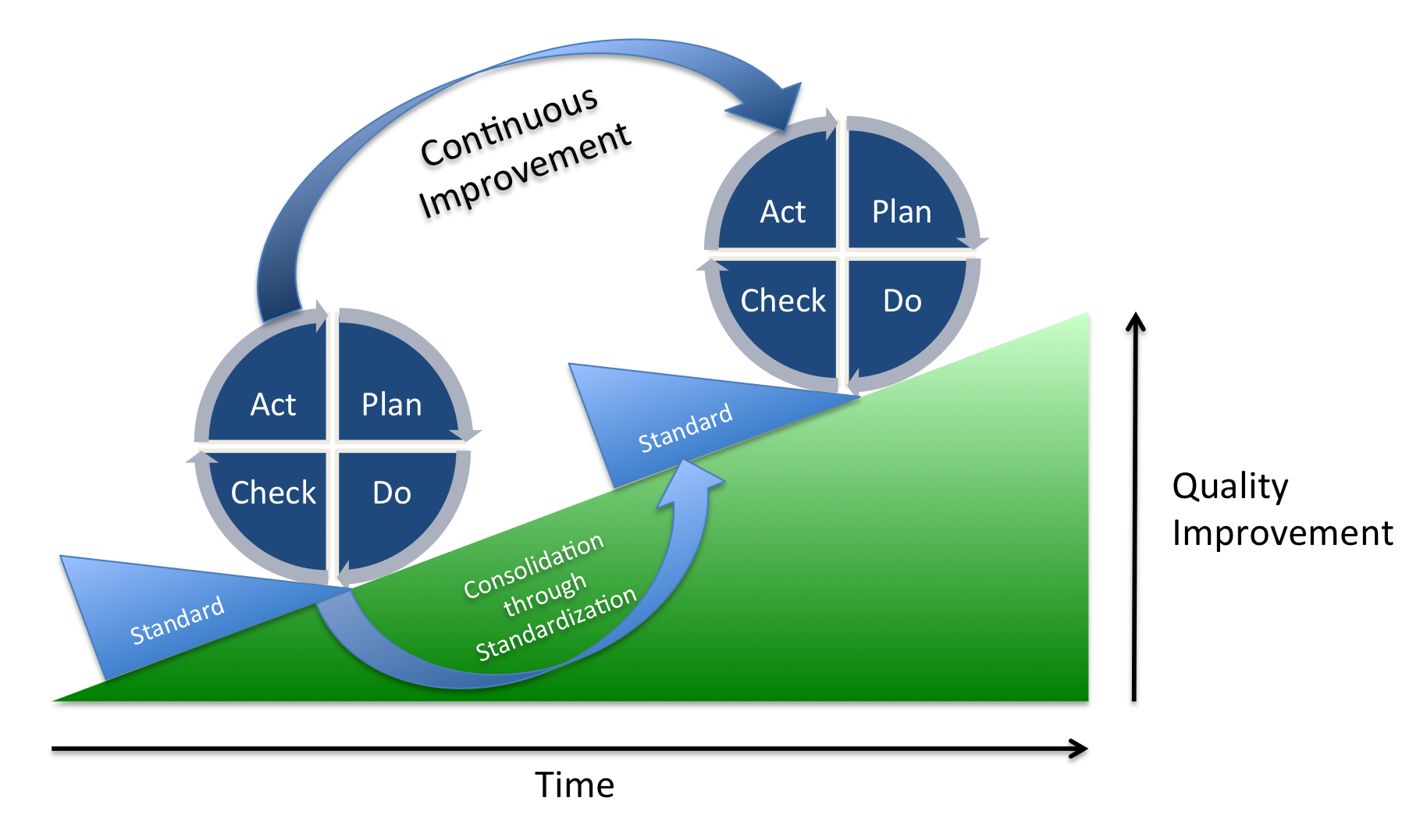
Performance management is the process organizations use to help employees perform their jobs effectively and reach their full potential. It focuses on setting clear goals, providing regular feedback, and improving job performance over time. Rather than relying solely on annual evaluations, performance management is designed to be an ongoing and continuous process. This approach helps employees understand what is expected of them and how their work contributes to the success of the organization. According to Aguinis (2019), performance management systems are most effective when they emphasize continuous communication and support between managers and employees. When implemented successfully, performance management can improve motivation, productivity, and overall workplace performance.
Key Elements of Performance Management Systems
Performance management systems consist of several key components that work together to support employee success and organizational effectiveness. These components typically include goal setting, performance measurement, feedback, and employee development. Clear goals help employees understand their responsibilities and focus on important tasks within their roles. Measuring performance allows managers and employees to track progress and identify areas that may need improvement.
Regular feedback is another essential element of effective performance management. Feedback helps employees understand their strengths as well as opportunities for growth. Performance evaluations provide a more formal opportunity to assess progress and make decisions related to promotions, compensation, or professional development. In addition, training and development opportunities allow employees to build new skills and continue growing within the organization (Armstrong & Taylor, 2020).
Aligning Performance with Organizational Success
One of the primary goals of performance management is to connect individual employee performance with the broader goals of the organization. When employees understand how their work contributes to organizational success, they are more likely to remain motivated and engaged in their roles. Aligning individual goals with organizational objectives ensures that everyone is working toward shared outcomes.
Managers play an important role in creating this alignment. By establishing clear performance goals that support company objectives, managers help employees see the connection between their daily tasks and the organization's larger mission. Research suggests that organizations with strong goal alignment often experience higher levels of employee engagement and improved performance outcomes (DeNisi & Murphy, 2017). This alignment allows organizations to achieve both short-term results and long-term strategic success.
Challenges in Managing Performance
Although performance management provides many benefits, organizations may encounter challenges when implementing or maintaining these systems. One common challenge is unclear expectations, which can lead to confusion about job responsibilities and performance standards. When employees are unsure about what is expected of them, it becomes difficult to measure performance accurately.
Bias in performance evaluations can also create problems within the performance management process. If employees believe evaluations are unfair, it may reduce trust and morale within the organization. In addition, some employees may feel uncomfortable receiving feedback or may resist changes designed to improve performance.
Managers may also struggle to find sufficient time to provide regular coaching and feedback. In today's work environment, remote and hybrid work arrangements can create additional communication challenges. Addressing these issues requires clear expectations, consistent communication, and proper training for managers responsible for conducting performance evaluations (Aguinis, 2019).
Evolving Approaches to Performance Management
Performance management has changed over time to better meet employee and organizational needs. Many organizations are moving away from yearly performance reviews. Instead, they are using regular check-ins and ongoing feedback. These newer approaches focus more on employee growth and development. Technology now helps track performance and provide faster feedback. Modern performance management systems aim to support learning and improvement rather than just evaluation. These changes help organizations stay flexible and effective in today's fast-changing work environment (Armstrong & Taylor, 2020). To further understand the concept of performance management, watch the following 10-minute video. It provides a brief overview of how performance management systems work and why they are important in modern organizations.