

13.2: Delegation of Duties
- Page ID
- 143351

\( \newcommand{\vecs}[1]{\overset { \scriptstyle \rightharpoonup} {\mathbf{#1}} } \)
\( \newcommand{\vecd}[1]{\overset{-\!-\!\rightharpoonup}{\vphantom{a}\smash {#1}}} \)
\( \newcommand{\dsum}{\displaystyle\sum\limits} \)
\( \newcommand{\dint}{\displaystyle\int\limits} \)
\( \newcommand{\dlim}{\displaystyle\lim\limits} \)
\( \newcommand{\id}{\mathrm{id}}\) \( \newcommand{\Span}{\mathrm{span}}\)
( \newcommand{\kernel}{\mathrm{null}\,}\) \( \newcommand{\range}{\mathrm{range}\,}\)
\( \newcommand{\RealPart}{\mathrm{Re}}\) \( \newcommand{\ImaginaryPart}{\mathrm{Im}}\)
\( \newcommand{\Argument}{\mathrm{Arg}}\) \( \newcommand{\norm}[1]{\| #1 \|}\)
\( \newcommand{\inner}[2]{\langle #1, #2 \rangle}\)
\( \newcommand{\Span}{\mathrm{span}}\)
\( \newcommand{\id}{\mathrm{id}}\)
\( \newcommand{\Span}{\mathrm{span}}\)
\( \newcommand{\kernel}{\mathrm{null}\,}\)
\( \newcommand{\range}{\mathrm{range}\,}\)
\( \newcommand{\RealPart}{\mathrm{Re}}\)
\( \newcommand{\ImaginaryPart}{\mathrm{Im}}\)
\( \newcommand{\Argument}{\mathrm{Arg}}\)
\( \newcommand{\norm}[1]{\| #1 \|}\)
\( \newcommand{\inner}[2]{\langle #1, #2 \rangle}\)
\( \newcommand{\Span}{\mathrm{span}}\) \( \newcommand{\AA}{\unicode[.8,0]{x212B}}\)
\( \newcommand{\vectorA}[1]{\vec{#1}} % arrow\)
\( \newcommand{\vectorAt}[1]{\vec{\text{#1}}} % arrow\)
\( \newcommand{\vectorB}[1]{\overset { \scriptstyle \rightharpoonup} {\mathbf{#1}} } \)
\( \newcommand{\vectorC}[1]{\textbf{#1}} \)
\( \newcommand{\vectorD}[1]{\overrightarrow{#1}} \)
\( \newcommand{\vectorDt}[1]{\overrightarrow{\text{#1}}} \)
\( \newcommand{\vectE}[1]{\overset{-\!-\!\rightharpoonup}{\vphantom{a}\smash{\mathbf {#1}}}} \)
\( \newcommand{\vecs}[1]{\overset { \scriptstyle \rightharpoonup} {\mathbf{#1}} } \)
\(\newcommand{\longvect}{\overrightarrow}\)
\( \newcommand{\vecd}[1]{\overset{-\!-\!\rightharpoonup}{\vphantom{a}\smash {#1}}} \)
\(\newcommand{\ket}[1]{\left| #1 \right>}\)
\(\newcommand{\bra}[1]{\left< #1 \right|}\)
\(\newcommand{\braket}[2]{\left< #1 \vphantom{#2} \right| \left. #2 \vphantom{#1} \right>}\)
\(\newcommand{\braopket}[3]{\left< #1 \vphantom{#2}\vphantom{#3} \right| #2 \vphantom{#1}\vphantom{#3} \left| #3 \vphantom{#1}\vphantom{#2} \right>}\)
\(\newcommand{\qmvec}[1]{\mathbf{\vec{#1}}}\)
\(\newcommand{\op}[1]{\hat{\mathbf{#1}}}\)
\(\newcommand{\expect}[1]{\langle #1 \rangle}\)
\(\newcommand{\dfn}[1]{\emph{\textbf{#1}}}\)
LEARNING OBJECTIVES
- Know what a delegation of duty is.
- Recognize how liability remains on the delegator following a delegation.
- Understand what duties may not be delegated.
Delegation of Duties
Introductory Scenario
Imagine this: Sarah, a homeowner, hires Prime Builders to remodel her kitchen. The contract states that Prime Builders will complete the work for $50,000. After the agreement is signed, Prime Builders decides to subcontract the plumbing work to AquaPro Plumbing. Sarah wonders: “Do I have to accept performance from this new company? And if AquaPro makes mistakes, who is responsible—Prime Builders or AquaPro?”
This scenario illustrates the concept of delegation of duties—when one party to a contract transfers their responsibility to perform to someone else.
General Rule
Up to this point, we have focused on the assignment of rights (usually involving money payments). But contracts create duties as well as rights. Just as rights can be assigned, duties may be delegated.
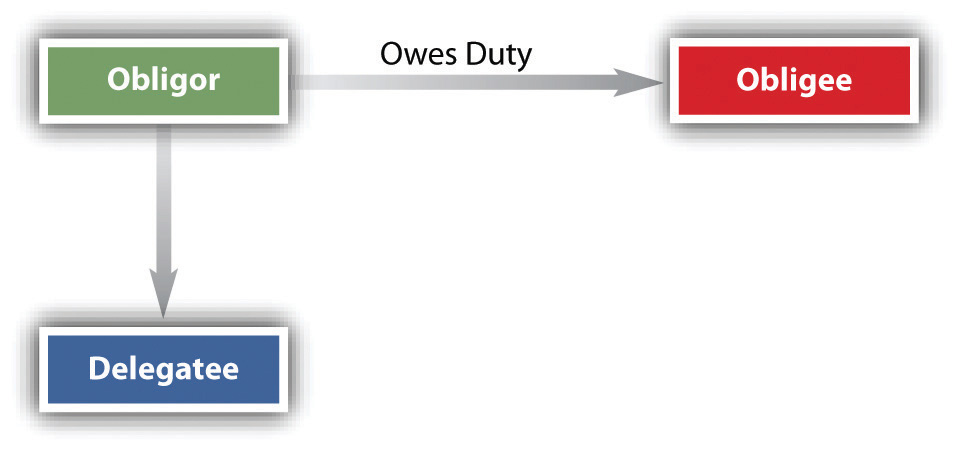
- The party who transfers the duty is the delegator (Prime Builders).
- The party who assumes the duty is the delegatee (AquaPro Plumbing).
- The party entitled to performance is the obligee (Sarah).
Unless the contract itself, or public policy, prohibits it, delegation is generally enforceable.
Common Law and the UCC
- Common Law (majority rule): An assignment of rights alone does not automatically include a delegation of duties. The delegator must expressly delegate.
- UCC § 2-210(4) and minority rule: An assignment of “the contract” or of “all my rights under the contract” is treated as both an assignment of rights and a delegation of duties. By accepting such an assignment, the delegatee is understood to have promised to perform.
Scenario tie-in: If Prime Builders simply assigned Sarah’s payments to a financing company, only the right to payment would be transferred. But if they assigned “the contract,” that would also imply AquaPro takes on the duty of performing the remodeling work.
Figure 14.3 Delegation of Duties
Liability After Delegation
Delegating a duty does not automatically release the delegator.
- Delegator remains liable: Prime Builders is still on the hook to Sarah, even if AquaPro fails to perform.
- Obligee may enforce against both: Sarah could sue AquaPro for poor plumbing, but she could also hold Prime Builders accountable, since Prime Builders originally promised to perform.
This contrasts with assignments, where the assignor generally steps out once the right is transferred.
Novation
A delegator can only escape liability through a novation—a new agreement in which the obligee agrees to release the original obligor and accept the delegatee as a substitute.
- Example: If Sarah, Prime Builders, and AquaPro all agree that AquaPro will fully take over the contract, and Prime Builders is released, this constitutes a novation. Sarah can no longer hold Prime Builders liable if AquaPro defaults.
Nondelegable Duties
Not all duties can be delegated.
-
Personal Services
If the contract involves unique skill, talent, or trust, performance must be personal.- Example: If Sarah had hired a famous interior designer known for her unique artistic vision, that designer could not delegate the design work to an assistant without Sarah’s consent.
-
Public Policy
Some duties are barred from delegation because they are tied to public trust or responsibility.- Example: A public official cannot delegate their elected duties to a private citizen.
-
Contractual Prohibition
The parties themselves may agree to forbid delegation. Courts generally enforce such clauses.- UCC § 2-210(3): In sales contracts, a prohibition on assigning “the contract” is interpreted as a bar on delegating duties.
Scenario tie-in: If Sarah’s remodeling contract explicitly stated, “Prime Builders must personally perform all work and may not delegate duties,” then AquaPro could not take over without Sarah’s approval.
KEY TAKEAWAY
Most contractual duties may be delegated, but the delegator remains liable unless there is a novation. Some duties—especially those involving personal skill, public policy, or express contractual prohibitions—are nondelegable.
Scenario wrap-up: In Sarah’s case, Prime Builders may delegate routine tasks like plumbing to AquaPro, but Prime Builders remains responsible for the final result unless Sarah formally agrees to release them through a novation.
EXERCISES
- What is the difference between an assignment and a delegation?
- Under what circumstances is the delegator discharged from liability on the contract?