

13.1: Assignment of Contract Rights
- Page ID
- 143350

\( \newcommand{\vecs}[1]{\overset { \scriptstyle \rightharpoonup} {\mathbf{#1}} } \)
\( \newcommand{\vecd}[1]{\overset{-\!-\!\rightharpoonup}{\vphantom{a}\smash {#1}}} \)
\( \newcommand{\dsum}{\displaystyle\sum\limits} \)
\( \newcommand{\dint}{\displaystyle\int\limits} \)
\( \newcommand{\dlim}{\displaystyle\lim\limits} \)
\( \newcommand{\id}{\mathrm{id}}\) \( \newcommand{\Span}{\mathrm{span}}\)
( \newcommand{\kernel}{\mathrm{null}\,}\) \( \newcommand{\range}{\mathrm{range}\,}\)
\( \newcommand{\RealPart}{\mathrm{Re}}\) \( \newcommand{\ImaginaryPart}{\mathrm{Im}}\)
\( \newcommand{\Argument}{\mathrm{Arg}}\) \( \newcommand{\norm}[1]{\| #1 \|}\)
\( \newcommand{\inner}[2]{\langle #1, #2 \rangle}\)
\( \newcommand{\Span}{\mathrm{span}}\)
\( \newcommand{\id}{\mathrm{id}}\)
\( \newcommand{\Span}{\mathrm{span}}\)
\( \newcommand{\kernel}{\mathrm{null}\,}\)
\( \newcommand{\range}{\mathrm{range}\,}\)
\( \newcommand{\RealPart}{\mathrm{Re}}\)
\( \newcommand{\ImaginaryPart}{\mathrm{Im}}\)
\( \newcommand{\Argument}{\mathrm{Arg}}\)
\( \newcommand{\norm}[1]{\| #1 \|}\)
\( \newcommand{\inner}[2]{\langle #1, #2 \rangle}\)
\( \newcommand{\Span}{\mathrm{span}}\) \( \newcommand{\AA}{\unicode[.8,0]{x212B}}\)
\( \newcommand{\vectorA}[1]{\vec{#1}} % arrow\)
\( \newcommand{\vectorAt}[1]{\vec{\text{#1}}} % arrow\)
\( \newcommand{\vectorB}[1]{\overset { \scriptstyle \rightharpoonup} {\mathbf{#1}} } \)
\( \newcommand{\vectorC}[1]{\textbf{#1}} \)
\( \newcommand{\vectorD}[1]{\overrightarrow{#1}} \)
\( \newcommand{\vectorDt}[1]{\overrightarrow{\text{#1}}} \)
\( \newcommand{\vectE}[1]{\overset{-\!-\!\rightharpoonup}{\vphantom{a}\smash{\mathbf {#1}}}} \)
\( \newcommand{\vecs}[1]{\overset { \scriptstyle \rightharpoonup} {\mathbf{#1}} } \)
\(\newcommand{\longvect}{\overrightarrow}\)
\( \newcommand{\vecd}[1]{\overset{-\!-\!\rightharpoonup}{\vphantom{a}\smash {#1}}} \)
\(\newcommand{\ket}[1]{\left| #1 \right>}\)
\(\newcommand{\bra}[1]{\left< #1 \right|}\)
\(\newcommand{\braket}[2]{\left< #1 \vphantom{#2} \right| \left. #2 \vphantom{#1} \right>}\)
\(\newcommand{\braopket}[3]{\left< #1 \vphantom{#2}\vphantom{#3} \right| #2 \vphantom{#1}\vphantom{#3} \left| #3 \vphantom{#1}\vphantom{#2} \right>}\)
\(\newcommand{\qmvec}[1]{\mathbf{\vec{#1}}}\)
\(\newcommand{\op}[1]{\hat{\mathbf{#1}}}\)
\(\newcommand{\expect}[1]{\langle #1 \rangle}\)
\(\newcommand{\dfn}[1]{\emph{\textbf{#1}}}\)
LEARNING OBJECTIVES
- Understand what an assignment is and how it is made.
- Recognize the effect of the assignment.
- Know when assignments are not allowed.
- Understand the concept of assignor’s warranties.
The Concept of a Contract Assignment (Assignment of Contract Rights)
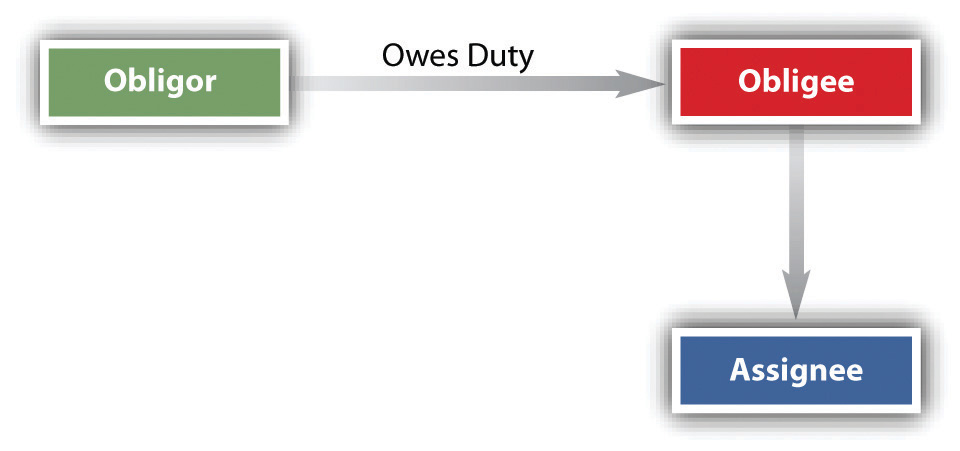
Contracts create both rights and duties. The party entitled to receive a benefit is called the obligee. That person may transfer their right to another person, known as the assignee. The act of transferring the right is called an assignment.
Once the transfer occurs, the original obligee (now the assignor) steps aside, and the assignee acquires the right to receive performance directly from the other party to the contract (the obligor). In short, the assignee “stands in the shoes” of the assignor.
Assignments are very common in business transactions:
- Banking: A bank may assign its rights under a mortgage or loan to another financial institution.
- Accounts receivable financing: A business may sell its outstanding invoices to a factoring company for immediate cash.
- Leases: A tenant may assign the right to occupy premises to another party, with the landlord’s consent.
Figure 14.1 Assignment of Rights
Method of Assignment
Manifesting Assent
For an assignment to be valid, the assignor must clearly express the intention to transfer rights immediately. The intention must be definite and present—not a vague promise to transfer later.
- Valid Assignment Example: “I hereby assign my right to collect $5,000 from James under our contract to Maria.”
- Invalid Promise Example: “I will assign my right to you next month.” (This is a promise to assign, not an actual assignment.)
Acceptance and Revocation
Most assignments require no special acceptance—especially when the assignee gives consideration (something of value) in exchange for the assignment. In those cases, the assignment is binding and cannot be revoked without the assignee’s consent.
Issues arise mainly with gratuitous assignments (those given as gifts). These are usually revocable unless:
- The assignee accepts the gift, or
- The assignor provides written notice of the assignment.
- Example: John assigns his right to collect rent from a tenant to his brother as a gift. Unless his brother accepts or receives written notice, John may revoke the assignment.
Notice to the Obligor
Once an assignment is made, the obligor—the party who owes performance—should be informed so they know where to direct their performance. Strictly speaking, notice to the obligor is not required for an assignment to be valid. However, whether or not notice is given can have serious consequences.
If the obligor has no notice of the assignment and performs by paying or delivering to the assignor, the obligor is discharged. The obligation has been satisfied, even though the assignee did not receive performance. In that situation, the assignor cannot keep the benefit; he owes it to the assignee.
But once the obligor has notice of the assignment, the rules change. If the obligor still performs to the assignor, that performance does not count, and the assignee can recover directly from either the obligor or the assignor. This could place the obligor in the unfair position of having to perform twice. (See Aldana v. Colonial Palms Plaza.)
Because of this risk, an obligor who receives notice of an assignment from someone claiming to be the assignee has a legitimate concern: How do I know the assignment is real? After all, anyone could show up and say, “I’m the assignee of your contract with the bank. From now on, pay me the $500 a month, not the bank.” The law recognizes this concern
Effect of Assignment
General Rule: Standing in the Shoes" of the Assignor
When a right is assigned, the assignee does not receive anything more than what the assignor had. Instead, the assignee effectively “stands in the shoes” of the assignor. This means the assignee acquires all the rights the assignor had against the obligor, but also takes those rights subject to any defenses or claims the obligor could have raised against the assignor.
In other words, if the obligor could have refused to perform for the assignor, the obligor can refuse to perform for the assignee on the same grounds. The assignment does not improve or enlarge the underlying rights—it simply transfers them.
The Uniform Commercial Code (UCC) § 9-318(1) reinforces this principle in the context of accounts: the assignee is bound by all the terms of the contract between the debtor (obligor) and the creditor-assignor.
Example
Dealer sells a car to Buyer under a contract where Buyer must pay $300 per month, and the car comes with a 50,000-mile warranty. Before 50,000 miles, the car breaks down, and Dealer refuses to honor the warranty. Buyer spends $250 on repairs and deducts that amount from the next installment payment (a practice known as a setoff).
Later, Dealer assigns the contract to Assignee. Because Assignee “stands in Dealer’s shoes,” Buyer has the same right to set off the $250 repair cost against the installment owed to Assignee. The assignment does not eliminate Buyer’s defenses—it simply changes the party to whom payment is owed.
Exceptions
The “shoe rule”—that an assignee takes only the rights the assignor had—does not apply in two situations: when a negotiable instrument is transferred to a holder in due course or when the obligor has waived defenses against an assignee. Even then, important limits apply: certain “real defenses” (like duress or fraud) always remain available, and consumer protection laws and FTC regulations often prevent waivers in consumer transactions.
When Assignments Are Not Allowed
The general rule is that most contract rights can be assigned. But there are important exceptions designed to protect fairness and prevent abuse. Below are the major situations in which assignments are restricted or prohibited.
Material Change in Duties of the Obligor
An assignment is ineffective if it would materially alter the obligor’s duties. The law allows routine changes (such as redirecting payments), but not changes that would fundamentally shift the nature of the performance.
- Example 1: A Centerville Times subscriber assigns his right to newspaper delivery to another person in town. This is valid because delivery obligations are routine and unchanged.
- Example 2: A parent hires a babysitter to care for her child every Saturday evening. The parent cannot assign her right to child care to a neighbor’s child without the babysitter’s consent, because caring for a different child would materially change the babysitter’s duties.
Assignments are generally valid when the contract does not involve a personal relationship—but consent may still be required in special contracts.
Assignment of Personal Rights
Contracts involving personal rights cannot be assigned, because it matters to the obligor who receives the performance.
- Example 1: A student agrees to do research work for a professor she admires. The professor assigns the contract to another colleague whom the student dislikes. The assignment is invalid.
- Example 2: An insurance company issues a policy to a careful sixty-five-year-old driver. He cannot assign the policy to his reckless teenage grandson, because the insurer contracted based on his personal risk profile.
Personal services and most tenancy agreements fall under this category.
Assignment Forbidden by Statute or Public Policy
Some assignments are restricted by law or public policy. Legislatures often step in to prevent exploitation or unfairness.
- Example 1: Federal and state laws limit the assignment of future wages to protect workers from selling off their income due to financial hardship.
- Example 2: Certain public benefits (like workers’ compensation) cannot be assigned, to ensure they serve their intended purpose.
Contracts That Prohibit Assignment
Parties may include a no-assignment clause in their agreement. Courts usually respect these clauses, but with limitations.
- Under the Restatement (Second) of Contracts §322 and UCC §2-210(3), a general prohibition on assigning “the contract” usually bars only the delegation of duties, not the assignment of rights.
- Example 1: A lease may forbid a tenant from subletting without the landlord’s consent.
- Example 2: Even if a land sale contract prohibits assignment, some states still allow the buyer to assign the right to receive title after paying in full.
The UCC also invalidates clauses that attempt to prohibit assigning rights to damages or sums already due.
Future Contracts
The law distinguishes between future rights under an existing contract (which may be assigned) and rights under a future contract (which may not).
- Example 1: Ben has a standing deal to shovel Mrs. Robinson’s walkway for $20 per snowfall. He assigns his friend the right to his next four payments. The assignment is valid.
- Example 2: Ben cannot assign rights under a snow-shoveling contract he hopes to make next year, because no such contract exists yet.
Partial Assignments
Assignments may cover only part of a contractual right if the obligation can be separated. This is most common with money payments.
- Example 1: Ben assigns half ($50) of the $100 Mrs. Robinson owes him to a friend. The assignment is valid.
- Example 2: If Mrs. Robinson disputes the arrangement, both Ben and the friend must join in a lawsuit to enforce payment, ensuring all parties are present in court.
Successive Assignments
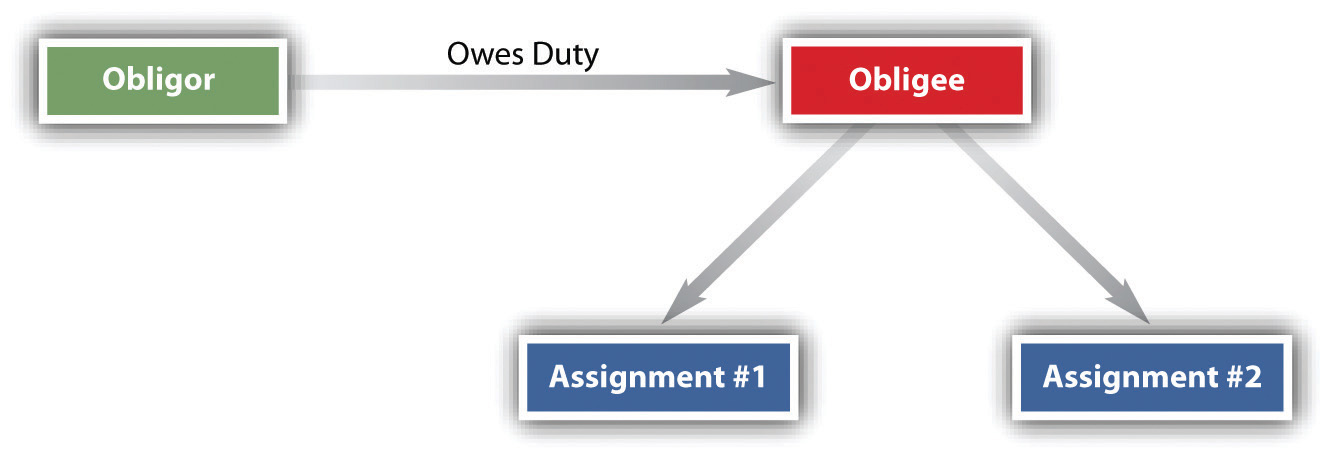
Sometimes an assignor wrongfully assigns the same right to more than one assignee. Priority depends on jurisdiction and circumstances.
- General Rule (U.S.): The first assignee in time usually prevails, unless the assignment was revocable or invalid.
- Exceptions: A later assignee may prevail if he qualifies as a bona fide purchaser (BFP)—that is, he (1) gave consideration in good faith, (2) had no knowledge of earlier assignments, and (3) obtained performance, judgment, or tangible evidence of the right. In that situation, the later assignee’s interest will take priority over the earlier one.
- English Rule (some states): The first assignee to give notice to the obligor has priority, regardless of the order of assignment.
- UCC Article 9: For assignments subject to filing, the first assignee to file will prevail.
Figure 14.2 Successive Assignments
Assignor’s Warranties
An assignor—the person transferring a contractual right—carries certain legal responsibilities when making an assignment. He cannot casually assign the same interest multiple times or transfer rights he does not actually have without facing liability. To protect assignees, the law recognizes assignor’s warranties, unless the contract explicitly provides otherwise.
When a right is assigned for value (not as a gift), the assignor implicitly promises:
- That the assignment is valid – The assignor will not take steps to defeat or undo the assignment.
- That he has the right to assign – The assignor truly owns the right being transferred.
- That there are no undisclosed defenses – The obligor does not have defenses that would make the right worthless.
However, the assignor does not guarantee the obligor’s performance. An assignment is not a promise that the obligor is solvent or will actually pay; it only guarantees that the right itself is genuine.
KEY TAKEAWAY
Generally, it is OK for an obligee to assign the right to receive contractual performance from the obligor to a third party. The effect of the assignment is to make the assignee stand in the shoes of the assignor, taking all the latter’s rights and all the defenses against nonperformance that the obligor might raise against the assignor. But the obligor may agree in advance to waive defenses against the assignee, unless such waiver is prohibited by law.
There are some exceptions to the rule that contract rights are assignable. Some, such as personal rights, are not circumstances where the obligor’s duties would materially change, cases where assignability is forbidden by statute or public policy, or, with some limits, cases where the contract itself prohibits assignment. Partial assignments and successive assignments can happen, and rules govern the resolution of problems arising from them.
When the assignor makes the assignment, that person makes certain warranties, express or implied, to the assignee, basically to the effect that the assignment is good and the assignor knows of no reason why the assignee will not get performance from the obligor.
EXERCISES
- If Able makes a valid assignment to Baker of his contract to receive monthly rental payments from Tenant, how is Baker’s right different from what Able’s was?
- Able made a valid assignment to Baker of his contract to receive monthly purchase payments from Carr, who bought an automobile from Able. The car had a 180-day warranty, but the car malfunctioned within that time. Able had quit the auto business entirely. May Carr withhold payments from Baker to offset the cost of needed repairs?
- Assume in the case in Exercise 2 that Baker knew Able was selling defective cars just before his (Able’s) withdrawal from the auto business. How, if at all, does that change Baker’s rights?
- Why are leases generally not assignable? Why are insurance contracts not assignable?