

19.10: Multiple Choice
- Page ID
- 94811

\( \newcommand{\vecs}[1]{\overset { \scriptstyle \rightharpoonup} {\mathbf{#1}} } \) \( \newcommand{\vecd}[1]{\overset{-\!-\!\rightharpoonup}{\vphantom{a}\smash {#1}}} \)\(\newcommand{\id}{\mathrm{id}}\) \( \newcommand{\Span}{\mathrm{span}}\) \( \newcommand{\kernel}{\mathrm{null}\,}\) \( \newcommand{\range}{\mathrm{range}\,}\) \( \newcommand{\RealPart}{\mathrm{Re}}\) \( \newcommand{\ImaginaryPart}{\mathrm{Im}}\) \( \newcommand{\Argument}{\mathrm{Arg}}\) \( \newcommand{\norm}[1]{\| #1 \|}\) \( \newcommand{\inner}[2]{\langle #1, #2 \rangle}\) \( \newcommand{\Span}{\mathrm{span}}\) \(\newcommand{\id}{\mathrm{id}}\) \( \newcommand{\Span}{\mathrm{span}}\) \( \newcommand{\kernel}{\mathrm{null}\,}\) \( \newcommand{\range}{\mathrm{range}\,}\) \( \newcommand{\RealPart}{\mathrm{Re}}\) \( \newcommand{\ImaginaryPart}{\mathrm{Im}}\) \( \newcommand{\Argument}{\mathrm{Arg}}\) \( \newcommand{\norm}[1]{\| #1 \|}\) \( \newcommand{\inner}[2]{\langle #1, #2 \rangle}\) \( \newcommand{\Span}{\mathrm{span}}\)\(\newcommand{\AA}{\unicode[.8,0]{x212B}}\)
1.
The term working capital is synonymous with ________.
-
accounts payable
-
current assets
-
equity
-
current liabilities
2.
The formula for net working capital is ________.
-
Current Assets – Current Liabilities
-
Fixed Assets – Current Assets
-
Assets – Liabilities
-
Current Assets – Liabilities
3.
When sales are made on credit, which current assets typically increase at the time of the sale?
-
cash
-
notes receivable
-
accounts receivable
-
marketable securities
4.
Which of the following is NOT a goal of working capital management?
-
meet the operational needs of the company
-
satisfy obligations (current liabilities) as they come due
-
maintain an optimal level of current assets
-
maximize the investment in current assets
5.
Accelerated Growth Inc. has the following account balances at year-end.
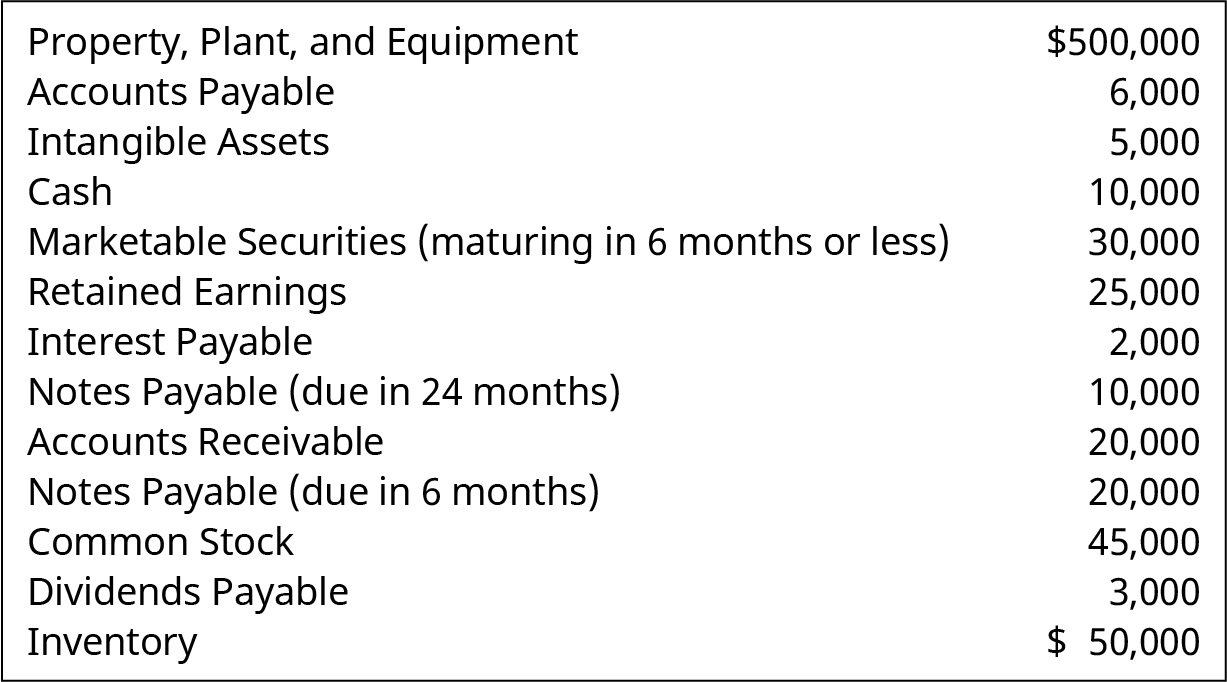
What is the cash ratio?
-
1.29
-
1.43
-
1.71
-
.088
6.
Which of the following is true of these credit terms: 3/15, n/30?
-
15 percent discount if the payable is paid within 3 days of the invoice date
-
3 percent discount if the payable is paid in the period between 15 days and 30 days after the invoice date
-
3 percent discount if the payable is paid within 15 days of the invoice date
-
30 percent discount if cash is paid on the sale date and 15% discount if paid 3 days after the invoice date
7.
When reviewing its budgets, including the cash budget, management of Transcend Inc. have considered best-case and worst-case scenarios. As they completed their analysis, it was decided because of the possibility of unexpected repairs and unanticipated higher labor costs to add another $30,000 to the amount of the target cash balance to maintain throughout the year. The reason for this action would be which of these motives for holding cash?
-
transaction motive
-
opportunity cost mitigation motive
-
precautionary motive
-
speculative motive
8.
A large retailer has more than $100 million of cash and cash equivalents on its balance sheet. Which of the following would not be part of the cash equivalents?
-
cash in banks (checking account balances)
-
US Treasury bond maturing in two years
-
receivables from a bank that processes credit card payments
-
commercial paper
9.
An account receivable is created when ________.
-
a customer pays its bill
-
a company accepts a credit card, such as VISA or MasterCard
-
a company sells to a customer on an open account
-
a company sells to a customer only on a cash basis
10.
Jackson’s Moonshine LLC has a receivables collection period of 47 days. Which the following would be reasonable conclusions?
-
Jackson’s Moonshine LLC is most likely experiencing serious liquidity issues.
-
Jackson’s Moonshine LLC is most overinvested in marketable securities.
-
If the industry average is 31 days, Jackson’s management should attempt strategies that will lower their receivables collection period.
-
If the industry average is 53 days, Jackson’s management should attempt strategies that will raise their receivables collection period.
11.
Two Way Power Ltd. (2WP) stocks an inventory item, BB3, that is projected to be in great demand over the next 12 months. In discussing its sales forecasts with its suppliers, a reasonable estimate shows that 2WP could lose about $30,000 of sales in month 3 due to inventory financing difficulties. Which, if any, of the following inventory costs would be affected by this development?
-
purchase cost
-
carrying costs
-
ordering costs
-
stockout costs
-
none of these costs because loss of sales is not an inventory cost
12.
If a company has significant inventory in each element of the value chain, it most likely is descriptive of ________.
-
the cost of goods sold of a retailer
-
the inventory balances held by wholesalers and service firms
-
the materials, work in process, and finished goods of a manufacturer
-
the inventory on the shelves of an e-commerce retailer