

6.3: Variable Costing
- Page ID
- 26076

\( \newcommand{\vecs}[1]{\overset { \scriptstyle \rightharpoonup} {\mathbf{#1}} } \)
\( \newcommand{\vecd}[1]{\overset{-\!-\!\rightharpoonup}{\vphantom{a}\smash {#1}}} \)
\( \newcommand{\dsum}{\displaystyle\sum\limits} \)
\( \newcommand{\dint}{\displaystyle\int\limits} \)
\( \newcommand{\dlim}{\displaystyle\lim\limits} \)
\( \newcommand{\id}{\mathrm{id}}\) \( \newcommand{\Span}{\mathrm{span}}\)
( \newcommand{\kernel}{\mathrm{null}\,}\) \( \newcommand{\range}{\mathrm{range}\,}\)
\( \newcommand{\RealPart}{\mathrm{Re}}\) \( \newcommand{\ImaginaryPart}{\mathrm{Im}}\)
\( \newcommand{\Argument}{\mathrm{Arg}}\) \( \newcommand{\norm}[1]{\| #1 \|}\)
\( \newcommand{\inner}[2]{\langle #1, #2 \rangle}\)
\( \newcommand{\Span}{\mathrm{span}}\)
\( \newcommand{\id}{\mathrm{id}}\)
\( \newcommand{\Span}{\mathrm{span}}\)
\( \newcommand{\kernel}{\mathrm{null}\,}\)
\( \newcommand{\range}{\mathrm{range}\,}\)
\( \newcommand{\RealPart}{\mathrm{Re}}\)
\( \newcommand{\ImaginaryPart}{\mathrm{Im}}\)
\( \newcommand{\Argument}{\mathrm{Arg}}\)
\( \newcommand{\norm}[1]{\| #1 \|}\)
\( \newcommand{\inner}[2]{\langle #1, #2 \rangle}\)
\( \newcommand{\Span}{\mathrm{span}}\) \( \newcommand{\AA}{\unicode[.8,0]{x212B}}\)
\( \newcommand{\vectorA}[1]{\vec{#1}} % arrow\)
\( \newcommand{\vectorAt}[1]{\vec{\text{#1}}} % arrow\)
\( \newcommand{\vectorB}[1]{\overset { \scriptstyle \rightharpoonup} {\mathbf{#1}} } \)
\( \newcommand{\vectorC}[1]{\textbf{#1}} \)
\( \newcommand{\vectorD}[1]{\overrightarrow{#1}} \)
\( \newcommand{\vectorDt}[1]{\overrightarrow{\text{#1}}} \)
\( \newcommand{\vectE}[1]{\overset{-\!-\!\rightharpoonup}{\vphantom{a}\smash{\mathbf {#1}}}} \)
\( \newcommand{\vecs}[1]{\overset { \scriptstyle \rightharpoonup} {\mathbf{#1}} } \)
\(\newcommand{\longvect}{\overrightarrow}\)
\( \newcommand{\vecd}[1]{\overset{-\!-\!\rightharpoonup}{\vphantom{a}\smash {#1}}} \)
\(\newcommand{\ket}[1]{\left| #1 \right>}\)
\(\newcommand{\bra}[1]{\left< #1 \right|}\)
\(\newcommand{\braket}[2]{\left< #1 \vphantom{#2} \right| \left. #2 \vphantom{#1} \right>}\)
\(\newcommand{\braopket}[3]{\left< #1 \vphantom{#2}\vphantom{#3} \right| #2 \vphantom{#1}\vphantom{#3} \left| #3 \vphantom{#1}\vphantom{#2} \right>}\)
\(\newcommand{\qmvec}[1]{\mathbf{\vec{#1}}}\)
\(\newcommand{\op}[1]{\hat{\mathbf{#1}}}\)
\(\newcommand{\expect}[1]{\langle #1 \rangle}\)
\(\newcommand{\dfn}[1]{\emph{\textbf{#1}}}\)
Variable costing (also known as direct costing) treats all fixed manufacturing costs as period costs to be charged to expense in the period received. Under variable costing, companies treat only variable manufacturing costs as product costs. The logic behind this expensing of fixed manufacturing costs is that the company would incur such costs whether a plant was in production or idle. Therefore, these fixed costs do not specifically relate to the manufacture of products. The following video explains the concepts in variable costing:
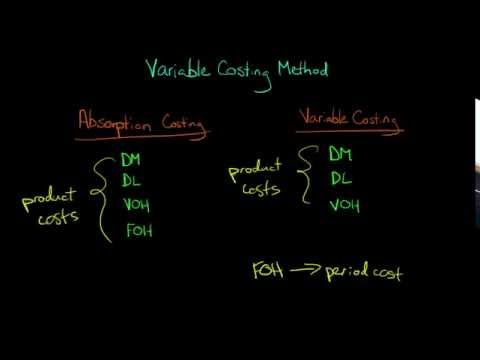
A YouTube element has been excluded from this version of the text. You can view it online here: pb.libretexts.org/llmanagerialaccounting/?p=140
Product costs, under variable costing, includes the VARIABLE costs only like direct materials, direct labor and variable overhead. Fixed overhead would not be included as a product cost! We calculate product cost per unit as:
| Direct Materials |
| + Direct Labor |
| + Variable Overhead |
| = Total Product Cost |
| ÷ Total Units Produced |
| = Product cost per unit |
The income statement we will use in not Generally Accepted Accounting Principles so is not typically included in published financial statements outside the company. This contribution margin income statement would be used for internal purposes only. You should remember, the contribution margin income statement separates variable costs and fixed costs (whether product or period does not matter) and calculates a contribution margin (this is sales – variable costs). Now, let’s continue with our example Bradley Company.
Bradley Company had the following information for May:
Direct materials $13,000First, we will calculate the variable cost product cost per unit:
| Direct Materials | $ 13,000 |
| + Direct Labor | $ 15,000 |
| + Variable Overhead | $ 5,000 |
| = Total Product Cost | $ 33,000 |
| ÷ Total Units Produced | ÷ 10,000 |
| = Product cost per unit | $ 3.30 |
Next, we calculate the contribution margin format income statement under variable costing:
| Bradley Company | ||
| Income Statement (variable) | ||
| For Month Ended May | ||
| Sales (9,000 x $8 per unit) | $ 72,000 | |
| Variable Costs: | ||
| Cost of goods sold (9,000 x $3.30 per unit) | 29,700 | |
| Selling expenses (9,000 x $0.20 per unit) | 1,800 | |
| Total variable costs | 31,500 | |
| Contribution Margin | 40,500 | |
| Fixed Costs: | ||
| Fixed overhead (fixed portion only) | 6,000 | |
| Selling expenses (fixed portion only) | 15,000 | |
| Administrative expenses | 12,000 | |
| Total Fixed expenses | 33,000 | |
| Net Operating Income | $ 7,500 | |
In variable costing, it is important to remember:
ONLY includes variable costs meaning costs that increase with volumeContributors and Attributions
- Accounting Principles: A Business Perspective.. Authored by: James Don Edwards, University of Georgia & Roger H. Hermanson, Georgia State University.. Provided by: Endeavour International Corporation. Project: The Global Text Project.. License: CC BY: Attribution
- Variable Costing (the Variable Costing method in Managerial Accounting) . Authored by: Education Unlocked. Located at: youtu.be/kfJqYGQOLes. License: All Rights Reserved. License Terms: Standard YouTube License