

11: Chapter 11: IG for Digital Communications and Collaboration
- Page ID
- 157259
\( \newcommand{\vecs}[1]{\overset { \scriptstyle \rightharpoonup} {\mathbf{#1}} } \)
\( \newcommand{\vecd}[1]{\overset{-\!-\!\rightharpoonup}{\vphantom{a}\smash {#1}}} \)
\( \newcommand{\dsum}{\displaystyle\sum\limits} \)
\( \newcommand{\dint}{\displaystyle\int\limits} \)
\( \newcommand{\dlim}{\displaystyle\lim\limits} \)
\( \newcommand{\id}{\mathrm{id}}\) \( \newcommand{\Span}{\mathrm{span}}\)
( \newcommand{\kernel}{\mathrm{null}\,}\) \( \newcommand{\range}{\mathrm{range}\,}\)
\( \newcommand{\RealPart}{\mathrm{Re}}\) \( \newcommand{\ImaginaryPart}{\mathrm{Im}}\)
\( \newcommand{\Argument}{\mathrm{Arg}}\) \( \newcommand{\norm}[1]{\| #1 \|}\)
\( \newcommand{\inner}[2]{\langle #1, #2 \rangle}\)
\( \newcommand{\Span}{\mathrm{span}}\)
\( \newcommand{\id}{\mathrm{id}}\)
\( \newcommand{\Span}{\mathrm{span}}\)
\( \newcommand{\kernel}{\mathrm{null}\,}\)
\( \newcommand{\range}{\mathrm{range}\,}\)
\( \newcommand{\RealPart}{\mathrm{Re}}\)
\( \newcommand{\ImaginaryPart}{\mathrm{Im}}\)
\( \newcommand{\Argument}{\mathrm{Arg}}\)
\( \newcommand{\norm}[1]{\| #1 \|}\)
\( \newcommand{\inner}[2]{\langle #1, #2 \rangle}\)
\( \newcommand{\Span}{\mathrm{span}}\) \( \newcommand{\AA}{\unicode[.8,0]{x212B}}\)
\( \newcommand{\vectorA}[1]{\vec{#1}} % arrow\)
\( \newcommand{\vectorAt}[1]{\vec{\text{#1}}} % arrow\)
\( \newcommand{\vectorB}[1]{\overset { \scriptstyle \rightharpoonup} {\mathbf{#1}} } \)
\( \newcommand{\vectorC}[1]{\textbf{#1}} \)
\( \newcommand{\vectorD}[1]{\overrightarrow{#1}} \)
\( \newcommand{\vectorDt}[1]{\overrightarrow{\text{#1}}} \)
\( \newcommand{\vectE}[1]{\overset{-\!-\!\rightharpoonup}{\vphantom{a}\smash{\mathbf {#1}}}} \)
\( \newcommand{\vecs}[1]{\overset { \scriptstyle \rightharpoonup} {\mathbf{#1}} } \)
\(\newcommand{\longvect}{\overrightarrow}\)
\( \newcommand{\vecd}[1]{\overset{-\!-\!\rightharpoonup}{\vphantom{a}\smash {#1}}} \)
\(\newcommand{\avec}{\mathbf a}\) \(\newcommand{\bvec}{\mathbf b}\) \(\newcommand{\cvec}{\mathbf c}\) \(\newcommand{\dvec}{\mathbf d}\) \(\newcommand{\dtil}{\widetilde{\mathbf d}}\) \(\newcommand{\evec}{\mathbf e}\) \(\newcommand{\fvec}{\mathbf f}\) \(\newcommand{\nvec}{\mathbf n}\) \(\newcommand{\pvec}{\mathbf p}\) \(\newcommand{\qvec}{\mathbf q}\) \(\newcommand{\svec}{\mathbf s}\) \(\newcommand{\tvec}{\mathbf t}\) \(\newcommand{\uvec}{\mathbf u}\) \(\newcommand{\vvec}{\mathbf v}\) \(\newcommand{\wvec}{\mathbf w}\) \(\newcommand{\xvec}{\mathbf x}\) \(\newcommand{\yvec}{\mathbf y}\) \(\newcommand{\zvec}{\mathbf z}\) \(\newcommand{\rvec}{\mathbf r}\) \(\newcommand{\mvec}{\mathbf m}\) \(\newcommand{\zerovec}{\mathbf 0}\) \(\newcommand{\onevec}{\mathbf 1}\) \(\newcommand{\real}{\mathbb R}\) \(\newcommand{\twovec}[2]{\left[\begin{array}{r}#1 \\ #2 \end{array}\right]}\) \(\newcommand{\ctwovec}[2]{\left[\begin{array}{c}#1 \\ #2 \end{array}\right]}\) \(\newcommand{\threevec}[3]{\left[\begin{array}{r}#1 \\ #2 \\ #3 \end{array}\right]}\) \(\newcommand{\cthreevec}[3]{\left[\begin{array}{c}#1 \\ #2 \\ #3 \end{array}\right]}\) \(\newcommand{\fourvec}[4]{\left[\begin{array}{r}#1 \\ #2 \\ #3 \\ #4 \end{array}\right]}\) \(\newcommand{\cfourvec}[4]{\left[\begin{array}{c}#1 \\ #2 \\ #3 \\ #4 \end{array}\right]}\) \(\newcommand{\fivevec}[5]{\left[\begin{array}{r}#1 \\ #2 \\ #3 \\ #4 \\ #5 \\ \end{array}\right]}\) \(\newcommand{\cfivevec}[5]{\left[\begin{array}{c}#1 \\ #2 \\ #3 \\ #4 \\ #5 \\ \end{array}\right]}\) \(\newcommand{\mattwo}[4]{\left[\begin{array}{rr}#1 \amp #2 \\ #3 \amp #4 \\ \end{array}\right]}\) \(\newcommand{\laspan}[1]{\text{Span}\{#1\}}\) \(\newcommand{\bcal}{\cal B}\) \(\newcommand{\ccal}{\cal C}\) \(\newcommand{\scal}{\cal S}\) \(\newcommand{\wcal}{\cal W}\) \(\newcommand{\ecal}{\cal E}\) \(\newcommand{\coords}[2]{\left\{#1\right\}_{#2}}\) \(\newcommand{\gray}[1]{\color{gray}{#1}}\) \(\newcommand{\lgray}[1]{\color{lightgray}{#1}}\) \(\newcommand{\rank}{\operatorname{rank}}\) \(\newcommand{\row}{\text{Row}}\) \(\newcommand{\col}{\text{Col}}\) \(\renewcommand{\row}{\text{Row}}\) \(\newcommand{\nul}{\text{Nul}}\) \(\newcommand{\var}{\text{Var}}\) \(\newcommand{\corr}{\text{corr}}\) \(\newcommand{\len}[1]{\left|#1\right|}\) \(\newcommand{\bbar}{\overline{\bvec}}\) \(\newcommand{\bhat}{\widehat{\bvec}}\) \(\newcommand{\bperp}{\bvec^\perp}\) \(\newcommand{\xhat}{\widehat{\xvec}}\) \(\newcommand{\vhat}{\widehat{\vvec}}\) \(\newcommand{\uhat}{\widehat{\uvec}}\) \(\newcommand{\what}{\widehat{\wvec}}\) \(\newcommand{\Sighat}{\widehat{\Sigma}}\) \(\newcommand{\lt}{<}\) \(\newcommand{\gt}{>}\) \(\newcommand{\amp}{&}\) \(\definecolor{fillinmathshade}{gray}{0.9}\)
Chapter 11: IG for Digital Communications and Collaboration
Introduction
In 2026, the way organizations communicate has changed as dramatically as the places they keep their records. Email is still the backbone of business correspondence, but decision‑making also happens in chat threads, short‑form video clips, collaboration channels, mobile apps, and even through signals exchanged by IoT devices. Each of these mediums creates business records and risk—they carry sensitive information, may be subject to discovery or regulatory access, and can be misused for fraud or disinformation. Information Governance (IG) for digital communications means designing policies, controls, and training that ensure communications are purposeful, secure, retrievable, and compliant—without smothering productivity.
Three forces shape today’s playbook. First, zero‑trust thinking has moved from networks into collaboration: access is continuously verified, least‑privilege is enforced, and every message can be logged as evidence when required. NIST’s Zero Trust Architecture (ZTA) provides a widely adopted blueprint for this mindset across cloud and on‑prem resources, including collaboration systems. Second, compliance and e‑discovery have “caught up” with collaboration tools: email‑style retention, legal hold, and search are now expected for Teams, Slack, and other platforms—though important nuances remain. Third, the communications surface now includes mobile and IoT endpoints, requiring enterprise device management, threat defense, and BYOD guardrails to meet privacy and security obligations. NIST’s mobile guidance (SP 800‑124 Rev.2) anchors today’s enterprise practices for securing smartphones and tablets used for work. [csrc.nist.gov] [learn.microsoft.com] [csrc.nist.gov]
This chapter offers a practical framework for integrating IG across email, social media (X/TikTok), collaboration platforms (Teams/Slack), and mobile/IoT communications. You’ll find policy templates, control checklists, platform comparisons, and case studies you can adapt for class projects or real organizations. We ground the guidance in credible sources that auditors, counsel, and cybersecurity teams already recognize: NIST for security controls and identity, Cloud Security Alliance for cloud responsibility and SaaS baselines, IAPP/EDPB for privacy, and ARMA for IG maturity. [csrc.nist.gov], [cdn.prod.w...-files.com], [iapp.org], [todaysgene...ounsel.com]
Email Governance
Email remains the most universal business communications channel—and the one most often implicated in regulatory requests, HR matters, and litigation. A defensible email program blends retention, archiving, monitoring/anti‑abuse, and incident response with auditable evidence.
Why email is still special for IG
- Regulatory discoverability: Email is routinely requested in investigations; courts and agencies expect organizations to locate and produce it quickly.
- High‑value evidence & risk: Email threads capture approvals, intent, and timelines. They also carry phishing payloads and can be spoofed to authorize fraudulent payments. NIST highlights phishing’s evolution (including AI‑assisted lures) and recommends layered defenses and staff education. [nist.gov]
- Control coverage: The NIST SP 800‑53 control catalog provides technology‑agnostic controls that apply to messaging systems—e.g., SI‑8 (Spam Protection) and related email hygiene measures—while NIST’s overlay repository includes an Email Messaging Systems Overlay for tailoring controls to email. [csf.tools], [csrc.nist.gov]
Retention and archiving
Retention defines how long to keep messages; archiving is how you store and retrieve them. The principle is simple: retain what you must, dispose of what you should not keep. For Microsoft 365 tenants, Purview Data Lifecycle Management (retention policies/labels) can apply rules to Exchange mailboxes and support holds when litigation is anticipated. Teams chat and channels are also covered (see next section), but email retention remains a separate policy scope and must be set explicitly. [learn.microsoft.com]
Practical steps
- Map obligations: Identify legal/regulatory retention baselines (e.g., tax, employment, sector rules). Align schedules with enterprise retention policies.
- Implement policy + technology: Use centralized retention policies to keep email for a defined period and delete after expiry unless on hold. Configure immutable archives where required. [learn.microsoft.com]
- Enable legal holds: When litigation is reasonably anticipated, place custodial holds to suspend deletion; maintain a case record describing scope and justification. [syscloud.com]
- Document exceptions: If certain functions (e.g., board communications) require longer retention, use label‑based exceptions with DPO/Legal approval and written rationale. [learn.microsoft.com]
Monitoring and anti‑phishing
Email security should combine technical controls (gateway filtering, DMARC/DKIM/SPF, sandboxing, link protection, malware detection) with human factors (simulated phishing, training, and clear reporting). NIST’s guidance for small and large organizations stresses that phishing now spans email, SMS, voice, and social media, and that employees need simple “report a phish” paths and just‑in‑time education. SP 800‑53 SI‑8 codifies spam protection at entry/exit points with automatic updates; CSF 2.0 provides an overall risk‑management context for deploying these defenses. [nist.gov], [csf.tools], [nist.gov]
Governance note: Retention is not backup: if a mailbox falls outside policy or a hold, “deleted” email might be unrecoverable for legal purposes. Your IG policy should explain the difference between backup and retention and instruct staff to use approved archives for records, not PST files or personal mailboxes. [magnetclicks.com]
Social Media and Public Platforms (X/TikTok)
Public platforms are powerful for outreach and brand, but they pose IG risks: unapproved disclosures, records sprawl, privacy exposure, and regulatory obligations. Social content can be discoverable, particularly when it communicates business positions or customer service actions.
Content classification and acceptable use
IG should classify social content (e.g., Marketing, Customer Support, Executive Communications, Recruiting) and define what must be retained as records. ARMA’s contemporary thought leadership and events emphasize the need to embed IG in modern channels and treat them as potential official records tied to retention schedules. [magazine.arma.org], [govevents.com]
Acceptable use should forbid posting confidential or regulated data, require brand/legal review for high‑risk topics, and mandate screenshots/exports for significant business interactions (e.g., customer complaint resolution on X). Privacy‑by‑design requires that programs avoid collecting more data than necessary and comply with GDPR/CCPA transparency rules when using social messaging for support. IAPP toolkits and trackers can help align policy with evolving privacy laws. [iapp.org]
Platform-Specific Risks and Governance Controls (TikTok, X, Reddit)
Why Platform Nuance Matters Your Information Governance (IG) control set must reflect each social platform’s unique design, data practices, and moderation models. These factors change how content spreads, what gets logged, how long it persists, and which laws apply. Treating all platforms identically leaves organizations vulnerable to platform-specific data collection practices, algorithmic virality, and emerging jurisdictional mandates (such as youth protections and consumer disclosures) [vorlon.io].
TikTok
-
Algorithmic Amplification & Virality: TikTok’s recommendation systems and AI-generated content (AIGC) tooling can rapidly amplify accidental disclosures (e.g., whiteboards, security badges, or client data visible in the background). TikTok’s own Digital Services Act (DSA) risk assessment outlines these systemic risks. IG should treat every frame as potentially public and mandate pre-publication checks (e.g., “no filming in restricted areas,” blur/background-safe reviews) [jdsupra.com].
-
Data Collection Concerns: External analyses highlight extensive device/telemetry collection. Businesses must factor these privacy implications into their risk assessments for official accounts and employee devices, requiring work-profile isolation on mobile devices and verifying regional data-handling disclosures [sf16-va.ti...tokcdn.com], [tiktok.com], [linkedin.com].
-
Personal Information & Takedowns: TikTok’s Community Guidelines prohibit sharing high-risk personal information (home addresses, credentials) and ban phishing or malware. Your playbook should map these rules to your incident response: capture evidence, request removal citing the specific guideline, and record the artifacts [securitybo...levard.com].
X (formerly Twitter)
-
The Speed and Permanence Paradox: X’s high-velocity posting and quote-tweet dynamics can spread sensitive statements globally before they are noticed internally, while third-party integrations routinely archive these posts.
-
Business Records: Treat official X posts and Direct Messages (DMs) dealing with customer issues as business records when they commit the organization to action. Maintain a capture workflow (native exports or third-party archiving) to satisfy retention and eDiscovery requirements.
-
Approval Workflows: Apply dual approval for high-risk topics (finance, health, M&A, crisis response) and confirm compliant audience targeting when running youth-facing campaigns or promotions [vorlon.io].
Reddit (and Community Platforms)
-
Community-Moderated Disclosures: Subreddit threads often entice employees to discuss work under pseudonyms, but corporate affiliations are easily doxxed or inferred. Acceptable use policies must include a strict “no business disclosures on personal accounts” clause, supported by brand monitoring for mentions of confidential projects [vorlon.io].
-
Scraping & AI Training Risks: Increasing data scraping across social platforms for analytics and AI training raises privacy and intellectual property concerns when employees upload original work, internal screenshots, or customer stories. IG should warn content creators about these risks, and legal teams must review licensing/consent for any user-generated content the brand republishes [natlawreview.com].
Youth and Jurisdictional Considerations Several jurisdictions now impose strict age restrictions and special duties for youth protection on social platforms. For example, Australia’s eSafety regime (and 2025 social media age restrictions) classifies X, TikTok, YouTube, Twitch, and Reddit as age-restricted, expecting platforms to take “reasonable steps” to prevent under-16 accounts. Even if your organization is not consumer-facing, all staff outreach, marketing creative briefs, and recruiting communications must respect these local restrictions and validate that they do not encourage under-16 engagement [esafety.gov.au], [vorlon.io].
Operational Controls and Incident Response Checklist
To effectively govern these channels, organizations should add the following practical controls to their IG framework:
-
Per-Platform Risk Register: Document systemic risks for each platform (e.g., algorithmic amplification on TikTok, thread virality on X, community leaks on Reddit) and map them to specific mitigations like whitelists, geo-fencing, and takedown workflows [jdsupra.com], [securitybo...levard.com], [vorlon.io].
-
Age-Restriction Compliance: Require a jurisdictional review before launching campaigns. Log exactly how you limited targeting, disabled DMs, or implemented additional warnings for youth protection [vorlon.io].
-
Mobile Isolation: Mandate managed work profiles (MDM/EMM) and restrict copy/save functions for social media apps used on corporate or BYOD devices handling official accounts, tying this directly to the enterprise mobile policy [magazine.arma.org].
-
Evidence Capture & Takedown SOP: Establish a coordinated takedown playbook between Legal, Comms, and Security. Standardize the process of capturing forensic evidence (screenshots/URLs) and citing platform-specific legal rules (e.g., personal-info guidelines) before submitting removal requests [securitybo...levard.com], [blog.rsisecurity.com].
-
Enterprise IR Integration: Configure brand monitoring for unauthorized accounts or leaked content. Record all social media incident actions in a central case file and link them to the enterprise Incident Response plan (e.g., NIST IR/CSF functions) [nist.gov].
Collaboration and Messaging Tools (Teams/Slack)
Teams, Slack, and similar platforms are now core to how organizations work. They also create high‑velocity evidence and regulated records. Mature IG programs implement retention, archiving, legal holds, DLP, and access controls specifically for collaboration data.
Why collaboration data is different from email
- Non‑custodial, conversational context: Threads span many users and locations; single “messages” may not convey full meaning without context and reactions. Courts and regulators increasingly request channel‑level records, and practitioners must preserve threads, timestamps, edit history, reactions, and linked files. The Sedona Conference’s 2025 commentary spotlights these complexities. [everlaw.com]
- Rapid platform change: Storage architecture and compliance surfaces evolve—organizations must track vendor announcements to avoid gaps. For example, Microsoft announced a shift (rolling out in late 2025) to store Teams private‑channel messages in the team’s group mailbox rather than user mailboxes, affecting e‑discovery/holds and retention scoping. [techcommun...rosoft.com], [nikkichapple.com]
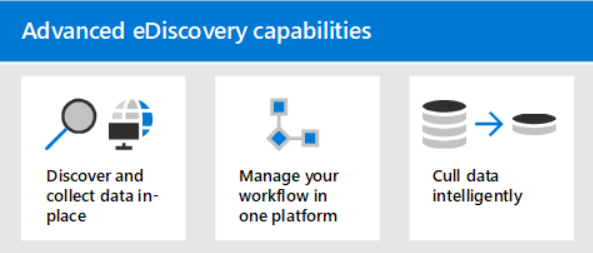
Figure 11.1 Microsoft 365 eDiscovery (Premium) architecture—how email, Teams, and files are preserved, searched, reviewed, and exported.
Retention, archiving, and legal holds in Teams
Microsoft documents how retention policies apply to Teams chats/channels and how deleted/edited messages remain discoverable while under retention/hold. Admins should scope policies to users and teams (for chats and channels respectively) and ensure case‑based eDiscovery holds protect relevant content. With the private‑channel change, group mailboxes become the target for new content; historical items under hold may still reside in user mailboxes—so search both until migration is complete. [learn.microsoft.com], [nikkichapple.com]
Key practices
- Define default retention for chats/channels (e.g., keep 2–7 years for regulated teams; shorter for general collaboration if allowed).
- Use eDiscovery (Premium) for case management, holds, review sets, and exports with defensible workflows. Understand limits: eDiscovery is not a backup. [magnetclicks.com]
- Review compliance licensing (often E5 or add‑ons) for DLP, audit, Insider Risk, Information Barriers, and eDiscovery features. [msadvance.com]
Retention, legal holds, and discovery in Slack
Slack Enterprise plans support legal holds to preserve messages/files for specific custodians and conversations; content can be accessed via Discovery API or JSON exports. IG teams must understand scope: some items (e.g., Slack Connect content or certain reactions/history) may fall outside holds depending on configuration, and deleted channels can impact preservation if not captured. A 2025 industry guide explains Slack’s architecture and strategies for defensible preservation and review. Always supplement policy with tooling that reconstructs threads for legal review. [slack.com], [jdsupra.com]
Governance guidance
- Publish a collaboration policy (who can create channels, invite externals, when to use Slack vs. email, prohibited data types).
- Configure DLP to detect and block sensitive data (PII, payment, health) in chats, file uploads, and connected apps.
- Apply information barriers or private channels for regulated teams (e.g., research vs. sales).
- Train users that collaboration content is discoverable and subject to retention. [msadvance.com]
AI features and risks
Generative and summarization features in collaboration suites can store prompts and outputs and may surface sensitive context in summaries. Apply least privilege, avoid ingesting regulated data into models unless approved, and log access/prompt history within your eDiscovery/records boundary. The Cloud Security Alliance’s recent works and key responsibility models help teams clarify shared responsibility for data in SaaS AI features and key management. [cloudsecur...liance.org], [cdn.prod.w...-files.com]
Mobile and IoT Communications
Mobile devices—and, increasingly, wearables and IoT edge sensors—are part of the communications fabric. They send chat messages, record short videos, capture field data, and connect to collaboration apps. IG must extend policy and controls to these endpoints.
BYOD vs. corporate‑owned
NIST SP 800‑124 Rev.2 outlines strategies for managing corporate‑owned and personally owned (BYOD) devices in the enterprise, including centralized device management and endpoint protection. A balanced approach uses Mobile Device Management (MDM) or Enterprise Mobility Management (EMM) to enforce screen locks, OS patching, app allow/deny lists, encrypted storage, and remote wipe. For BYOD, use app‑level management/containers to separate work data from personal content and to respect privacy. [csrc.nist.gov]
Secure messaging on mobile
- Enforce MFA integrated with your IdP for messaging/collaboration apps. NIST’s Digital Identity Guidelines (SP 800‑63‑4) update authentication guidance and acknowledge modern authenticators like passkeys. [pages.nist.gov]
- Require approved clients with managed app policies (e.g., block copy/paste to personal apps, restrict saving to non‑managed storage).
- Enable mobile threat defense to detect phishing over SMS and malicious networks/apps, per NIST’s mobile guidance emphasis on layered defense. [nist.gov], [lookout.com]
Data sovereignty and cross‑border issues
Mobile clients may sync data to cloud regions that trigger GDPR/CCPA obligations. Your device and collaboration policies should specify data‑residency choices and require vendors to document data‑flow maps and transfer safeguards (e.g., SCCs). CSA’s CCM and SaaS frameworks (SSCF) can be used to assess whether the provider exposes customer‑configurable controls for residency, logging, and key management. [cdn.prod.w...-files.com], [guidepoint...curity.com]
IoT communications
For devices that message back to the enterprise—wearables, room panels, scanners—document what is communicated, how it’s secured, where it’s stored, and retention. Apply network segmentation and device identity policies consistent with zero trust, and align with NIST control families (SP 800‑53) for logging, integrity, and access. [csrc.nist.gov]
IG Policies and Controls for Digital Communications
A workable program starts with clear policies, procedures, and standards mapped to risk and regulation, backed by training and monitoring.
Core policy set
- Acceptable Use: Defines allowed business use of email, chat, and social platforms; forbids confidential data in public channels; requires tone and behavior that reflect organizational values.
- Retention & Records: Declares which communications are records, assigns retention schedules, and prohibits shadow archiving (e.g., personal Gmail, local PSTs).
- eDiscovery & Legal Hold: Describes triggers, authorization, scope, and documentation for placing holds across email/Teams/Slack/social.
- Mobile/BYOD: Sets device compliance baseline, privacy boundaries for BYOD, and incident reporting obligations. [csrc.nist.gov]
- Incident Response for Leaks: Links communications platforms into the IR plan (e.g., phishing or social leak response, evidence capture). [nist.gov]
- Privacy & Consent: Explains when monitoring occurs (lawful, proportionate), references privacy notices, and aligns with GDPR/CCPA transparency.
Table — Policy checklist for digital communications
| Topic | What to cover | Why it matters |
|---|---|---|
| Retention & archiving | Schedules for email, chat, channels; archives and exports; exception handling | Enables discovery/compliance; prevents over‑retention risk. [learn.microsoft.com] |
| Legal holds | Triggers, custodians vs. channels, Slack holds, Teams group mailbox scope post‑change | Prevents spoliation; matches platform architecture. [slack.com], [nikkichapple.com] |
| Anti‑phishing | Technical controls (DMARC/DKIM/SPF, filtering), user reporting, training cadence | Reduces fraud and breach; aligns with NIST guidance. [nist.gov] |
| DLP & barriers | Patterns to block (PII, PCI, PHI), external sharing rules, information barriers | Prevents leakage in chat/files; supports regulated teams. [msadvance.com] |
| Mobile/BYOD | MDM/EMM baseline, containerization, app management, remote wipe | Secures mobile access to communications; respects privacy. [csrc.nist.gov] |
| Social media | Authorized accounts, content approvals, capture/archiving, takedown steps | Controls brand risk; ensures records capture. [magazine.arma.org] |
Audits and training
- Training: Simulated phishing (with coaching), collaboration etiquette (discoverability), and social risks; show what a retention banner means in Teams. [nist.gov], [learn.microsoft.com]
- Audits: Test whether holds properly preserve channels, whether DLP catches sensitive tokens, whether social archives are complete, and whether BYOD devices meet policy baselines. Use NIST CSF 2.0 to frame quarterly control reviews. [nist.gov]
Tools and Technologies
The stack that operationalizes IG for communications spans security, compliance, and governance.
- Microsoft Purview (M365): Sensitivity/retention labels, Data Loss Prevention, Information Barriers, Insider Risk, eDiscovery (Standard/Premium), and audit; document configuration and licensing in your controls register. [msadvance.com]
- Teams compliance: Retention for chats/channels, case holds, and new group‑mailbox scoping for private channels; verify search sources during migration to avoid gaps. [learn.microsoft.com], [techcommun...rosoft.com]
- Slack Enterprise features: Legal Holds, Discovery API, Enterprise Key Management, retention per channel/DM; pair with third‑party review tools to reconstruct threads. [slack.com]
- Cloud Security Alliance frameworks: CCM v5 and the SaaS Security Capability Framework (SSCF) help evaluate SaaS collaboration security (identity, logging, DLP, incident response). [cdn.prod.w...-files.com], [guidepoint...curity.com]
- Email security gateways: DMARC, anti‑malware, URL rewriting, impersonation detection, and quarantine workflows aligned to NIST SP 800‑53 SI‑8 controls. [csf.tools]
- Mobile security: MDM/EMM with mobile threat defense; policy templates aligned with NIST SP 800‑124r2. [csrc.nist.gov]
Table — Communication tool comparison (governance view)
| Capability | Teams | Slack | Social (X/TikTok) | |
|---|---|---|---|---|
| Retention | Mature, mailbox‑based | Chats/channels via Purview; private‑channel shift to group mailbox | Channel/DM retention; Enterprise holds | External archiving/capture required |
| Legal hold | Custodian‑based | eDiscovery case holds; include group mailbox for private channels | Legal Holds Admin role + Discovery API | Platform‑specific (limited); rely on capture & legal process |
| DLP | Mature | Extensive (files/chat) | Available via integrations/enterprise features | Limited; focus on policy, review, and takedown |
| Monitoring | Gateways + audit | Audit/insider risk | Audit APIs, admin logs | Brand/social listening; moderation dashboards |
| AI features | Summaries/assistants in clients | Meeting/chat summarization; Copilot | Workflow bots; third‑party AI | Content recommendation/ads; labeling duties |
(Validate current configurations before audits; vendors update frequently.) [learn.microsoft.com], [slack.com], [cdn.prod.w...-files.com]
Real‑World Case Studies
1) Short‑Form Video Leak on TikTok (Hypothetical but plausible)
Scenario: A product manager posted a behind‑the‑scenes TikTok showing a whiteboard with unreleased specs. The video went viral; competitors scraped frames.
Findings: No social media pre‑publication review; no guidance on filming in restricted areas; no central archive of official posts.
Response: Legal issued takedowns and documented efforts; Security captured copies and engaged incident response; Communications published a correction.
Fixes: Introduced content classification and approvals for official accounts; created a shooting‑safe checklist; implemented a third‑party social archive; trained teams using platform privacy/security guidance and platform risk assessments to inform policy. [tiktok.com], [sf16-va.ti...tokcdn.com]
2) Teams e‑Discovery Gap After Private‑Channel Architecture Change (Composite)
Scenario: During an employment dispute, Legal searched user mailboxes to collect relevant Teams private‑channel messages. Results were incomplete because new posts were stored in the team’s group mailbox after Microsoft’s 2025 change.
Findings: The eDiscovery playbook still assumed user‑mailbox scoping for private channels.
Fixes: Updated eDiscovery templates to include both user mailboxes (pre‑migration) and group mailboxes (post‑migration); refreshed retention policies and DLP scoping; ran a posture audit to confirm coverage. [techcommun...rosoft.com], [nikkichapple.com]
3) Slack Spoliation Risk (Realistic composite across cases)
Scenario: HR launched an internal investigation but did not place Slack legal holds. Months later, channel clean‑up policies removed older messages; reviewers could not reconstruct threads.
Findings: Policy treated Slack as “informal,” relying on email holds only; no Discovery API integration.
Fixes: Implemented Slack Legal Holds and adjusted retention to preserve investigative channels; deployed a review platform that reconstructs threads with timestamps and reactions; trained HR/Legal on non‑custodial collaboration evidence and Sedona best practices. [slack.com], [everlaw.com]
4) Mobile Device Breach via Smishing (Composite)
Scenario: A field manager approved a supplier change via SMS after receiving a “CFO” text with a link. The link harvested credentials and pivoted to email/Teams.
Findings: BYOD with no managed app policy; SMS‑based approvals not forbidden; weak MFA on mobile.
Fixes: Enforced app‑protected work profiles, MFA, and mobile threat defense; moved approvals into a managed workflow; rolled out phishing awareness covering SMS/social. [csrc.nist.gov], [nist.gov]
Challenges and Best Practices
Common challenges
- Shadow communications: Employees use personal apps (WhatsApp, personal Gmail, DMs on X/TikTok) for expedience, creating unmanaged records.
- Evolving platforms: Teams/Slack architectural shifts and new AI features can silently break eDiscovery or DLP coverage. [techcommun...rosoft.com]
- Non‑custodial data: Collaboration evidence resists email‑style collection; you need tools that preserve context. [everlaw.com]
- BYOD privacy tension: Strong controls must coexist with employee privacy expectations and regional laws. [csrc.nist.gov]
- SaaS shared responsibility: Customers misjudge what the provider secures vs. what they must configure; use CSA frameworks to clarify. [cdn.prod.w...-files.com], [guidepoint...curity.com]
Best practices
- Adopt zero‑trust principles in collaboration: least‑privilege, continuous authentication, and identity‑centric enforcement. [csrc.nist.gov]
- Write platform‑specific IG playbooks (email, Teams, Slack, social) with retention/hold steps and owner roles; test them with tabletop exercises. [learn.microsoft.com], [slack.com]
- Instrument monitoring & DLP to cover chat and file uploads; verify with red‑team style tests. [msadvance.com]
- Use CSA’s CCM/SSCF to assess SaaS collaboration capabilities (identity, logging, customer‑controlled keys, exportability). [cdn.prod.w...-files.com], [guidepoint...curity.com]
- Harden mobile/BYOD: require MDM/EMM enrollment or app‑level management; enforce passkeys/MFA; use mobile threat defense; document privacy boundaries. [csrc.nist.gov], [pages.nist.gov]
- Educate continuously: phishing beyond email, discoverability of chat, and confidentiality on social/video. [nist.gov]
Future Outlook
Over the next three years, three trends will reshape communications IG:
-
Unified retention across channels: Tooling will continue converging so that email, chat, meeting artifacts (transcripts, recordings), and social captures sit under one retention/hold policy plane with channel‑aware context. Microsoft’s ongoing changes for Teams private channels foreshadow a broader shift toward group/workspace‑centric evidence. [techcommun...rosoft.com]
-
Built‑in AI governance: Collaboration platforms will natively log prompts, summaries, and automated actions for eDiscovery. Expect CSA and NIST to publish additional mappings that tie AI activity to enterprise control catalogs and shared responsibility matrices. [cloudsecur...liance.org]
-
Mobile‑first compliance: As more staff work primarily from phones, regulators and courts will expect mobile message parity—meaning if your policy applies to email/chat on desktop, it must apply to the same content on mobile with equivalent retention, DLP, and hold capabilities. NIST’s guidance already assumes mobile as a first‑class enterprise endpoint. [csrc.nist.gov]
Learning Objectives
- Explain how IG applies to email, social media, collaboration platforms, and mobile/IoT communications.
- Design retention, archiving, and legal‑hold strategies for email and chat, accounting for platform architecture changes.
- Evaluate social media risks (X/TikTok) and build acceptable‑use, classification, and incident response processes.
- Apply NIST/CSA guidance to mobile/BYOD and SaaS collaboration, including zero‑trust and DLP.
- Plan audits and training that reinforce policy and produce defensible evidence.
Key Takeaways
- Email remains pivotal: couple retention/holds with anti‑phishing and gateway controls aligned to NIST. [csf.tools], [nist.gov]
- Collaboration evidence is contextual: use platform‑specific holds/retention and verify sources after vendor changes (e.g., Teams private‑channel group mailbox). [learn.microsoft.com], [techcommun...rosoft.com]
- Social is public—and a record: classify content, approve high‑risk posts, capture official accounts, and prepare takedowns. [magazine.arma.org]
- Mobile/BYOD is mainstream: implement MDM/EMM, app‑level controls, and threat defense per NIST SP 800‑124r2. [csrc.nist.gov]
- Use CSA/NIST frameworks to translate policy into platform controls and audits. [cdn.prod.w...-files.com], [csrc.nist.gov]
Discussion Questions
- Your organization uses Teams, Slack, and email across multiple regions. How would you structure retention and legal hold to ensure complete coverage during a global investigation? Cite specific platform behaviors that shape your plan. [learn.microsoft.com], [slack.com]
- Draft a BYOD communications clause that balances MDM requirements with employee privacy, mapping each rule to NIST SP 800‑124r2 guidance. [csrc.nist.gov]
- Propose a social media incident response playbook for a short‑form video leak, including evidence capture, takedown steps, and post‑mortem controls. [tiktok.com]
Further Reading
- NIST SP 800‑124 Rev.2: Mobile Device Security — https://csrc.nist.gov/pubs/sp/800/124/r2/final [csrc.nist.gov]
- NIST CSF 2.0 — https://www.nist.gov/cyberframework [nist.gov]
- Slack Help: Create and manage legal holds — https://slack.com/help/articles/4401...ge-legal-holds [slack.com]
- Cloud Security Alliance: Security Guidance & CCM — https://cloudsecurityalliance.org/re...h/publications [cdn.prod.w...-files.com]
- TikTok Community Guidelines (Privacy/Security) — https://www.tiktok.com/community-gui...vacy-security/ [tiktok.com]
Your Nerdy Example:

Peter Parker’s E.D.I.T.H. glasses in Spider-Man: Far From Home demonstrate the catastrophic risks of high-velocity digital communications lacking dual-approval workflows or pre-publication review.