

8.3: The Acceptance
- Page ID
- 143320

\( \newcommand{\vecs}[1]{\overset { \scriptstyle \rightharpoonup} {\mathbf{#1}} } \)
\( \newcommand{\vecd}[1]{\overset{-\!-\!\rightharpoonup}{\vphantom{a}\smash {#1}}} \)
\( \newcommand{\dsum}{\displaystyle\sum\limits} \)
\( \newcommand{\dint}{\displaystyle\int\limits} \)
\( \newcommand{\dlim}{\displaystyle\lim\limits} \)
\( \newcommand{\id}{\mathrm{id}}\) \( \newcommand{\Span}{\mathrm{span}}\)
( \newcommand{\kernel}{\mathrm{null}\,}\) \( \newcommand{\range}{\mathrm{range}\,}\)
\( \newcommand{\RealPart}{\mathrm{Re}}\) \( \newcommand{\ImaginaryPart}{\mathrm{Im}}\)
\( \newcommand{\Argument}{\mathrm{Arg}}\) \( \newcommand{\norm}[1]{\| #1 \|}\)
\( \newcommand{\inner}[2]{\langle #1, #2 \rangle}\)
\( \newcommand{\Span}{\mathrm{span}}\)
\( \newcommand{\id}{\mathrm{id}}\)
\( \newcommand{\Span}{\mathrm{span}}\)
\( \newcommand{\kernel}{\mathrm{null}\,}\)
\( \newcommand{\range}{\mathrm{range}\,}\)
\( \newcommand{\RealPart}{\mathrm{Re}}\)
\( \newcommand{\ImaginaryPart}{\mathrm{Im}}\)
\( \newcommand{\Argument}{\mathrm{Arg}}\)
\( \newcommand{\norm}[1]{\| #1 \|}\)
\( \newcommand{\inner}[2]{\langle #1, #2 \rangle}\)
\( \newcommand{\Span}{\mathrm{span}}\) \( \newcommand{\AA}{\unicode[.8,0]{x212B}}\)
\( \newcommand{\vectorA}[1]{\vec{#1}} % arrow\)
\( \newcommand{\vectorAt}[1]{\vec{\text{#1}}} % arrow\)
\( \newcommand{\vectorB}[1]{\overset { \scriptstyle \rightharpoonup} {\mathbf{#1}} } \)
\( \newcommand{\vectorC}[1]{\textbf{#1}} \)
\( \newcommand{\vectorD}[1]{\overrightarrow{#1}} \)
\( \newcommand{\vectorDt}[1]{\overrightarrow{\text{#1}}} \)
\( \newcommand{\vectE}[1]{\overset{-\!-\!\rightharpoonup}{\vphantom{a}\smash{\mathbf {#1}}}} \)
\( \newcommand{\vecs}[1]{\overset { \scriptstyle \rightharpoonup} {\mathbf{#1}} } \)
\(\newcommand{\longvect}{\overrightarrow}\)
\( \newcommand{\vecd}[1]{\overset{-\!-\!\rightharpoonup}{\vphantom{a}\smash {#1}}} \)
\(\newcommand{\ket}[1]{\left| #1 \right>}\)
\(\newcommand{\bra}[1]{\left< #1 \right|}\)
\(\newcommand{\braket}[2]{\left< #1 \vphantom{#2} \right| \left. #2 \vphantom{#1} \right>}\)
\(\newcommand{\braopket}[3]{\left< #1 \vphantom{#2}\vphantom{#3} \right| #2 \vphantom{#1}\vphantom{#3} \left| #3 \vphantom{#1}\vphantom{#2} \right>}\)
\(\newcommand{\qmvec}[1]{\mathbf{\vec{#1}}}\)
\(\newcommand{\op}[1]{\hat{\mathbf{#1}}}\)
\(\newcommand{\expect}[1]{\langle #1 \rangle}\)
\(\newcommand{\dfn}[1]{\emph{\textbf{#1}}}\)
LEARNING OBJECTIVES
- Define acceptance.
- Understand who may accept an offer.
- Know when the acceptance is effective.
- Recognize when silence is acceptance.
Acceptance
Acceptance is the voluntary act of the offeree by which they demonstrate agreement to the terms of the offer. To be effective, acceptance must (1) be made by the person to whom the offer was directed (or their authorized representative), (2) mirror the terms of the offer, and (3) be communicated in the manner required or invited by the offer.
The Restatement (Second) of Contracts § 32 provides that unless the offer clearly indicates otherwise, the offeree may accept either by making a promise or by beginning performance.
- Example (promise): A seller offers to sell a bicycle for $200. The buyer responds, “I agree to buy it for $200.” This constitutes acceptance by promise.
- Example (performance): A seller offers $100 to anyone who mows her lawn. The act of beginning to mow the lawn constitutes acceptance through performance.
Who May Accept?
Only the intended offeree has the legal power to accept an offer. An offer creates a contractual power of acceptance that belongs solely to the person or group to whom it is directed.
- If an offer is made to a specific individual, only that person (or an authorized agent) may accept.
- If an offer is made to the public at large, such as a reward offer, then anyone who meets the stated conditions may accept.
Courts focus on the intent of the offeror: the offeror decides who is invited to form a contract.
- Example (specific offeree): A homeowner offers to sell their house to Alice for $300,000. Only Alice—or her authorized agent—can accept. Bob cannot accept on Alice’s behalf unless Alice has given him authority.
- Example (offer to the public): A store advertises, “The first 50 customers tomorrow will receive a free gift.” Any member of the public who qualifies as one of the first 50 customers has the power to accept.
Stipulations as to Acceptance
Because the offeror is the “master of the offer,” they may dictate how acceptance must be made.
- If the offeror specifies the mode of acceptance (e.g., return mail, fax, or email), then that method must be followed for acceptance to be valid.
- If the offeror does not specify, acceptance is effective when transmitted by any reasonable method under the circumstances—often the same means used to communicate the offer or a customary method in the industry.
- Example: If the offer states, “You must reply by email,” a mailed letter would not constitute a valid acceptance.
- Example: If no mode is specified, responding by phone, email, or mail would typically be reasonable.
The Mailbox Rule
Timing plays a crucial role in contract law. The Mailbox Rule provides that an acceptance is effective once it is dispatched (e.g., placed in the mail, sent by courier, or transmitted electronically by an authorized method), even if the offeror has not yet received it.
This protects the offeree from losing the benefit of the bargain due to postal delays or other issues beyond their control.
- Important limits:
- The Mailbox Rule applies only to acceptances, not to rejections, counteroffers, or revocations (which are effective only when received).
- The rule does not apply if the offeror specifies a different method or timing.
- Example: On Monday, a seller offers to sell equipment to a buyer. On Tuesday, the buyer mails an acceptance letter. On Wednesday, before receiving the letter, the seller attempts to revoke. Under the mailbox rule, the contract was formed on Tuesday when the acceptance was mailed.
“Mailbox Rule” and Mode of Acceptance
The effectiveness of acceptance depends not just on timing but also on the mode used.
- If the offer specifies a required mode (e.g., “Reply by overnight courier”), the offeree must comply. A different method may still create a contract, but only when the offeror actually receives it.
- If the offer does not specify, any reasonable method under the circumstances is sufficient.
- Example (specified mode): A seller says, “Confirm by overnight courier.” If the buyer mails a standard letter instead, the acceptance is valid only upon receipt, not dispatch.
- Example (reasonable mode): If an offer simply says, “Let me know,” a mailed acceptance is effective when sent under the mailbox rule, since mail is a reasonable means.
Figure 9.1
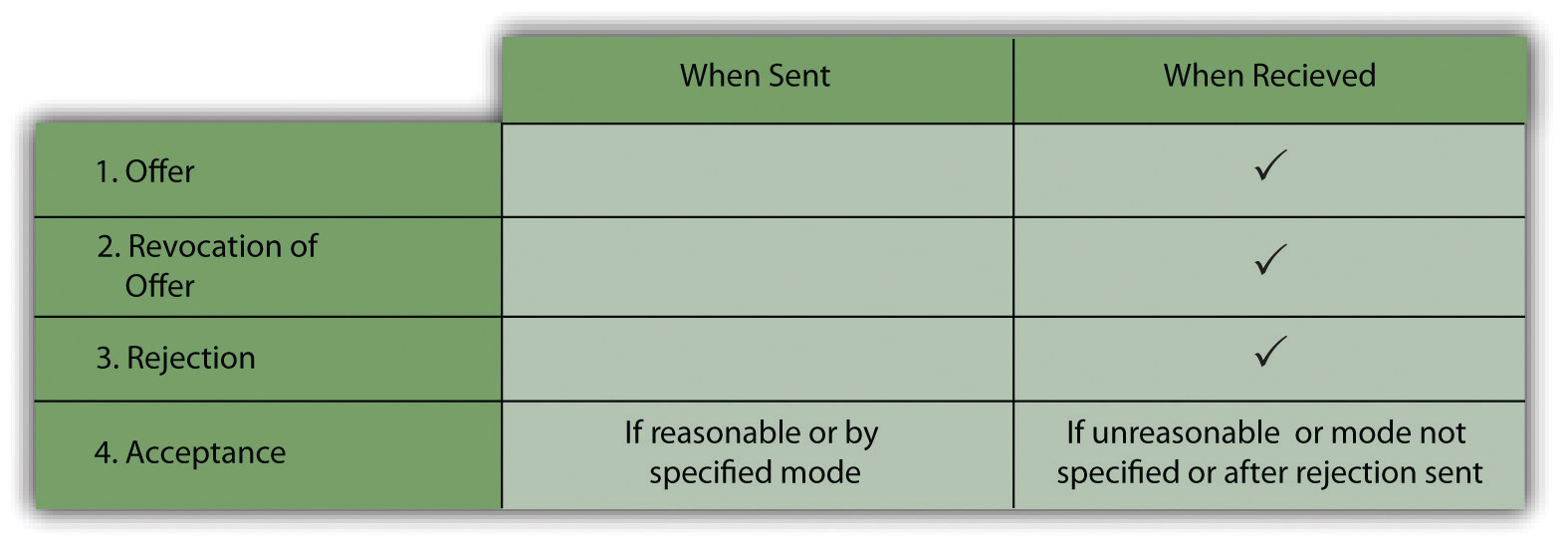
When Is Communication Effective?
Electronic Communications
Electronic communications have become a dominant method of contract formation. Many agreements are negotiated by email, accepted through online portals, and “signed” electronically. Generally speaking, these changes in medium do not alter the underlying rules of contract law.
To bring clarity, the Uniform Electronic Transactions Act (UETA) was promulgated in 1999 and adopted by most states (including California). Its purpose was to remove barriers to electronic commerce by validating electronic records and signatures. Under the UETA:
- A record or signature may not be denied legal effect solely because it is in electronic form.
- A contract may not be denied enforceability solely because an electronic record was used in its formation.
- If a law requires a writing, an electronic record satisfies the law.
- If a law requires a signature, an electronic signature satisfies the law.
In short, contracts can be validly created online just as they are in person, so long as the essential elements of offer, acceptance, and consideration are present.
Online Acceptances: Click-On Agreements
A common form of online contract is the click-on agreement (also called “clickwrap”). These occur when a user accepts terms and conditions by clicking an “I Agree” or “Accept” button before accessing software, websites, or apps. Courts routinely uphold click-on agreements as long as the terms are clearly presented and the user has an opportunity to review them before accepting.
- Example: A user downloading a software update is required to click “I Agree” to the terms of service before installation proceeds. By clicking, the user manifests assent, creating an enforceable contract.
Shrink-Wrap Terms
Another digital-age issue involves shrink-wrap licenses, where terms are enclosed inside product packaging or embedded within the software itself. By opening the package, installing the software, or using the product, the buyer is deemed to have accepted the terms. Courts generally enforce shrink-wrap terms so long as they are reasonably communicated and the buyer has an opportunity to reject the goods and return them for a refund.
- Example: A consumer purchases computer software. Inside the box is a license agreement stating that by opening the package or using the software, the consumer agrees to the terms. If the consumer installs and uses the software without objection, a court will typically enforce the license agreement.
Case Law: Specht v. Netscape Communications Corp.
While click-on and shrink-wrap agreements are often enforced, acceptance requires fair notice of terms. In Specht v. Netscape Communications Corp. (2d Cir. 2002), users downloaded free software by clicking a “Download” button. The licensing terms—including an arbitration clause—were hidden below the button and not visible unless the user scrolled down. The court held there was no valid acceptance because a reasonably prudent Internet user would not have known of the terms before downloading. Assent requires meaningful notice, not hidden provisions.
Limits of the Mailbox Rule in Electronic Contracts
Electronic communications also complicate the mailbox rule. If an email or fax is sent but not received—or overlooked—the traditional rule that acceptance is effective on dispatch may not apply. Courts look closely at the facts to determine whether there was reasonable notice.
- Example: If a faxed acceptance is never delivered due to machine error, a court may find no contract was formed because the offeror never received effective notice.
Silence as Acceptance
General Rule: Silence is not acceptance. A party generally must make some affirmative manifestation of assent.
Exceptions (Restatement § 69):
- The offeree takes offered services with a reasonable expectation of payment.
- Example: A carpenter offers to fix a collapsing porch. The homeowner says nothing but allows him to proceed. Acceptance by silence creates an implied contract.
- The offeror states silence may constitute acceptance, and the offeree intends to accept by remaining silent.
- Example: A friend offers to sell her car for $4,000, adding, “If I don’t hear from you, I’ll assume you accept.” If you remain silent intending to accept, a contract exists.
- Prior dealings create a reasonable expectation that silence is acceptance.
- Example: Justice Holmes’s Massachusetts case—where repeated business dealings meant silence reasonably signified assent unless otherwise communicated.
KEY TAKEAWAY
Without an acceptance of an offer, no contract exists, and once an acceptance is made, a contract is formed. If the offeror stipulates how the offer should be accepted, so be it. If there is no stipulation, any reasonable means of communication is good. Offers and revocations are usually effective upon receipt, while an acceptance is effective on dispatch. The advent of electronic contracting has caused some modification of the rules: courts are likely to investigate the facts surrounding the exchange of offer and acceptance more carefully than previously. But the nuances arising because of the mailbox rule and acceptance by silence still require close attention to the facts.
EXERCISES
- Rudy puts this poster, with a photo of his dog, on utility poles around his neighborhood: “$50 reward for the return of my lost dog.” Carlene doesn’t see the poster, but she finds the dog and, after looking at the tag on its collar, returns the dog to Rudy. As she leaves his house, her eye falls on one of the posters, but Rudy declines to pay her anything. Why is Rudy correct that Carlene has no legal right to the reward?
- How has the UCC changed the common law’s mirror image rule, and why?
- When is an offer generally said to be effective? A rejection of an offer? A counteroffer?
- How have modern electronic communications affected the law of offer and acceptance?
- When is silence considered an acceptance?