

3.2: Key concepts in market research
- Page ID
- 147941

\( \newcommand{\vecs}[1]{\overset { \scriptstyle \rightharpoonup} {\mathbf{#1}} } \)
\( \newcommand{\vecd}[1]{\overset{-\!-\!\rightharpoonup}{\vphantom{a}\smash {#1}}} \)
\( \newcommand{\dsum}{\displaystyle\sum\limits} \)
\( \newcommand{\dint}{\displaystyle\int\limits} \)
\( \newcommand{\dlim}{\displaystyle\lim\limits} \)
\( \newcommand{\id}{\mathrm{id}}\) \( \newcommand{\Span}{\mathrm{span}}\)
( \newcommand{\kernel}{\mathrm{null}\,}\) \( \newcommand{\range}{\mathrm{range}\,}\)
\( \newcommand{\RealPart}{\mathrm{Re}}\) \( \newcommand{\ImaginaryPart}{\mathrm{Im}}\)
\( \newcommand{\Argument}{\mathrm{Arg}}\) \( \newcommand{\norm}[1]{\| #1 \|}\)
\( \newcommand{\inner}[2]{\langle #1, #2 \rangle}\)
\( \newcommand{\Span}{\mathrm{span}}\)
\( \newcommand{\id}{\mathrm{id}}\)
\( \newcommand{\Span}{\mathrm{span}}\)
\( \newcommand{\kernel}{\mathrm{null}\,}\)
\( \newcommand{\range}{\mathrm{range}\,}\)
\( \newcommand{\RealPart}{\mathrm{Re}}\)
\( \newcommand{\ImaginaryPart}{\mathrm{Im}}\)
\( \newcommand{\Argument}{\mathrm{Arg}}\)
\( \newcommand{\norm}[1]{\| #1 \|}\)
\( \newcommand{\inner}[2]{\langle #1, #2 \rangle}\)
\( \newcommand{\Span}{\mathrm{span}}\) \( \newcommand{\AA}{\unicode[.8,0]{x212B}}\)
\( \newcommand{\vectorA}[1]{\vec{#1}} % arrow\)
\( \newcommand{\vectorAt}[1]{\vec{\text{#1}}} % arrow\)
\( \newcommand{\vectorB}[1]{\overset { \scriptstyle \rightharpoonup} {\mathbf{#1}} } \)
\( \newcommand{\vectorC}[1]{\textbf{#1}} \)
\( \newcommand{\vectorD}[1]{\overrightarrow{#1}} \)
\( \newcommand{\vectorDt}[1]{\overrightarrow{\text{#1}}} \)
\( \newcommand{\vectE}[1]{\overset{-\!-\!\rightharpoonup}{\vphantom{a}\smash{\mathbf {#1}}}} \)
\( \newcommand{\vecs}[1]{\overset { \scriptstyle \rightharpoonup} {\mathbf{#1}} } \)
\(\newcommand{\longvect}{\overrightarrow}\)
\( \newcommand{\vecd}[1]{\overset{-\!-\!\rightharpoonup}{\vphantom{a}\smash {#1}}} \)
\(\newcommand{\avec}{\mathbf a}\) \(\newcommand{\bvec}{\mathbf b}\) \(\newcommand{\cvec}{\mathbf c}\) \(\newcommand{\dvec}{\mathbf d}\) \(\newcommand{\dtil}{\widetilde{\mathbf d}}\) \(\newcommand{\evec}{\mathbf e}\) \(\newcommand{\fvec}{\mathbf f}\) \(\newcommand{\nvec}{\mathbf n}\) \(\newcommand{\pvec}{\mathbf p}\) \(\newcommand{\qvec}{\mathbf q}\) \(\newcommand{\svec}{\mathbf s}\) \(\newcommand{\tvec}{\mathbf t}\) \(\newcommand{\uvec}{\mathbf u}\) \(\newcommand{\vvec}{\mathbf v}\) \(\newcommand{\wvec}{\mathbf w}\) \(\newcommand{\xvec}{\mathbf x}\) \(\newcommand{\yvec}{\mathbf y}\) \(\newcommand{\zvec}{\mathbf z}\) \(\newcommand{\rvec}{\mathbf r}\) \(\newcommand{\mvec}{\mathbf m}\) \(\newcommand{\zerovec}{\mathbf 0}\) \(\newcommand{\onevec}{\mathbf 1}\) \(\newcommand{\real}{\mathbb R}\) \(\newcommand{\twovec}[2]{\left[\begin{array}{r}#1 \\ #2 \end{array}\right]}\) \(\newcommand{\ctwovec}[2]{\left[\begin{array}{c}#1 \\ #2 \end{array}\right]}\) \(\newcommand{\threevec}[3]{\left[\begin{array}{r}#1 \\ #2 \\ #3 \end{array}\right]}\) \(\newcommand{\cthreevec}[3]{\left[\begin{array}{c}#1 \\ #2 \\ #3 \end{array}\right]}\) \(\newcommand{\fourvec}[4]{\left[\begin{array}{r}#1 \\ #2 \\ #3 \\ #4 \end{array}\right]}\) \(\newcommand{\cfourvec}[4]{\left[\begin{array}{c}#1 \\ #2 \\ #3 \\ #4 \end{array}\right]}\) \(\newcommand{\fivevec}[5]{\left[\begin{array}{r}#1 \\ #2 \\ #3 \\ #4 \\ #5 \\ \end{array}\right]}\) \(\newcommand{\cfivevec}[5]{\left[\begin{array}{c}#1 \\ #2 \\ #3 \\ #4 \\ #5 \\ \end{array}\right]}\) \(\newcommand{\mattwo}[4]{\left[\begin{array}{rr}#1 \amp #2 \\ #3 \amp #4 \\ \end{array}\right]}\) \(\newcommand{\laspan}[1]{\text{Span}\{#1\}}\) \(\newcommand{\bcal}{\cal B}\) \(\newcommand{\ccal}{\cal C}\) \(\newcommand{\scal}{\cal S}\) \(\newcommand{\wcal}{\cal W}\) \(\newcommand{\ecal}{\cal E}\) \(\newcommand{\coords}[2]{\left\{#1\right\}_{#2}}\) \(\newcommand{\gray}[1]{\color{gray}{#1}}\) \(\newcommand{\lgray}[1]{\color{lightgray}{#1}}\) \(\newcommand{\rank}{\operatorname{rank}}\) \(\newcommand{\row}{\text{Row}}\) \(\newcommand{\col}{\text{Col}}\) \(\renewcommand{\row}{\text{Row}}\) \(\newcommand{\nul}{\text{Nul}}\) \(\newcommand{\var}{\text{Var}}\) \(\newcommand{\corr}{\text{corr}}\) \(\newcommand{\len}[1]{\left|#1\right|}\) \(\newcommand{\bbar}{\overline{\bvec}}\) \(\newcommand{\bhat}{\widehat{\bvec}}\) \(\newcommand{\bperp}{\bvec^\perp}\) \(\newcommand{\xhat}{\widehat{\xvec}}\) \(\newcommand{\vhat}{\widehat{\vvec}}\) \(\newcommand{\uhat}{\widehat{\uvec}}\) \(\newcommand{\what}{\widehat{\wvec}}\) \(\newcommand{\Sighat}{\widehat{\Sigma}}\) \(\newcommand{\lt}{<}\) \(\newcommand{\gt}{>}\) \(\newcommand{\amp}{&}\) \(\definecolor{fillinmathshade}{gray}{0.9}\)While the research field can be full of complex terminology, there are four key concepts to understand before conducting your own research:
- Research methodology
- Qualitative and quantitative data
- Primary and secondary research
- Sampling.
Research methodology
Research methodology refers to the process followed in order to conduct accurate and valuable research. The research process should involve certain steps.
- Establish the goals of the project
- Determine your sample
- Choose a data collection method
- Collect data
- Analyse the results
- Formulate conclusions and actionable insights (for example, producing reports)
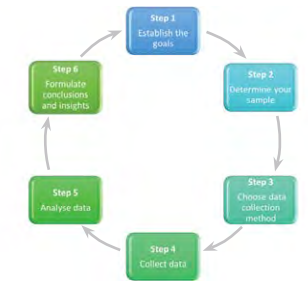
Most often, market research is focused around specific issues unique to a business or brand. It is therefore not always possible to freely obtain comparable information to aid decision making. This is why it can be useful to start from a specific research problem or hypothesis when kicking off a research project. Your research question should guide your entire process, and will determine your choice of data collection method. We will discuss more on those later.
Another approach involves ongoing data collection. As discussed in the Data driven decision making chapter, unbiased decision making is far more accurately driven when aided by market insight. Many have argued that less expensive, ongoing data collection is increasingly a route proven to be useful to organisations.
Primary and secondary research
Research can be based on primary data or secondary data. Primary research is conducted when new data is gathered for a particular product or hypothesis. This is where information does not exist already or is not accessible, and therefore needs to be specifically collected from consumers or businesses. Surveys, focus groups, research panels and research communities can all be used when conducting primary market research.
Secondary research uses existing, published data as a source of information. It can be more cost-effective than conducting primary research. The Internet opens up a wealth of resources for conducting this research. The data could have originally been collected for solving problems other than the one at hand, so they may not be sufficiently specific. Secondary research can be useful for identifying problems to be investigated through primary research.
The Internet is a useful tool when conducting both primary and secondary research. Not only are there a number of free tools available when it comes to calculating things such as sample size and confidence levels (see section 4.7 on Tools of the trade for some examples), but it is also an ideal medium to reach large numbers of people at a relatively low cost.
The Internet and secondary research
Research based on secondary data should precede primary data research. It can be used in establishing the context and parameters for primary research.
Secondary data can:
- provide enough information to solve the problem at hand, thereby negating the need for further research.
- provide sources for hypotheses that can be explored through primary research.
- provide information to inform primary research, such as sample sizes and audience.
- used as a reference base to measure the accuracy of primary research.
Companies with online properties have access to an abundance of web analytics data that are recorded digitally. These data can then be mined for insights. It’s worth remembering, though, that it’s usually impossible for you to access the web analytics data of competitors so this method will give you information only about your own customers.
Customer communications are also a source of data that can be used, particularly communications with the customer service department. Committed customers who complain, comment or compliment are providing information that can form the foundation for researching customer satisfaction.
Social networks, blogs and other forms of social media have emerged as forums where consumers discuss their likes and dislikes. Customers can be particularly vocal about companies and products. This data can, and should, be tracked and monitored to establish consumer sentiment. If a community is established for research purposes, the resulting feedback is considered primary data, but using social media to research existing sentiments is considered secondary research. The Internet is an ideal starting point for conducting secondary research based on published data and findings. With so much information out there, it can be a daunting task to find reliable resources.
The first point of call for research online is usually a search engine, such as www.google.com or www.yahoo.com. Search engines usually have an array of advanced features, which can aid online research. For example, Google offers:
- Advanced search: (http://www.google.co.za/advanced_search?hl=en)
- Google Scholar: (http://scholar.google.co.za/schhp?hl=en)
- Google Book Search: (http://www.google.co.za/books?hl=en)
- Google News Archive: (http://news.google.com/newspapers)
Many research publications are available online, some for free and some at a cost. Many of the top research companies feature analyst blogs, which provide some industry data and analysis free of charge.
Some notable resources are:
www.experian.com/hitwise
www.pewinternet.org (US data)
www.nielsen.com
The Internet and primary research
Primary research involves gathering data for a specific research task. It is based on data that has not been gathered beforehand. Primary research can be either qualitative or quantitative.
Primary research can be used to explore a market and can help to develop the hypotheses or research questions that must be answered by further research.
Generally, qualitative data is gathered at this stage. For example, online research communities can be used to identify consumer needs that are not being met and to brainstorm possible solutions. Further quantitative research can investigate what proportion of consumers share these problems and which potential solutions best meet those needs.
Quantitative and qualitative data
With larger sample sizes, qualitative data can be analysed quantitatively.
Data can be classified as qualitative or quantitative. Qualitative research is exploratory and seeks to find out what potential consumers think and feel about a given subject. Qualitative research aids in identifying potential hypotheses, whereas quantitative research puts hard numbers behind these hypotheses. Quantitative research relies on numerical data to demonstrate statistically significant outcomes.
The Internet can be used to gather both qualitative and quantitative data. In fact, the communities on the web can be viewed as large focus groups, regularly and willingly sharing their opinions about products, markets and companies.
In robust research studies, both qualitative and quantitative research can be applied at different stages of the study.
The main differences between quantitative and qualitative research are represented in Table 2 below.
| Quantitative | Qualitative | |
| Data gathered | Numbers, figures, statistics objective data | Opinions, feelings, motivations, subjective data |
| Question answered | What? | Why? |
| Group size | Large | Small |
| Data sources | Surveys, web analytics data | Focus groups, social media |
| Purpose |
Tests known issues or hypotheses. Seeks consensus, the norm Generalises data |
Generates ideas and concepts – leads to issues or hypotheses to be tested. Seeks complexity Puts data in context |
| Advantages | Statistically reliable results to determine if one option is better than the alternatives. | Looks at the context of issues and aims to understand perspectives. |
| Challenges |
Issues can be measured only if they are known prior to starting. Sample size must be sufficient for predicting the population |
Shouldn’t be used to evaluate pre-existing ideas. Results are not predictors of the population. |
Both quantitative and qualitative research can be conducted online.
Web analytics packages are a prime source of data. Using data such as search terms, referral URLs and internal search data can lead to qualitative information about the consumers visiting a website. However, when data is measurable and specific, such as impressions and clickthrough rates, it leads to quantitative research.
Read more about this in the Data analytics chapter.
Sampling
Qualitative research is usually conducted with a small number of respondents in order to explore and generate ideas and concepts. Quantitative research is conducted with far larger numbers, enough to be able to predict how the total population would respond.
You should ensure the sample is representative of the population you are targeting as a whole. If your business transacts both online and offline, be aware that using only online channels for market research might not represent your true target market. However, if your business transacts only online, offline channels for your market research are less necessary.
Because quantitative research aims to produce predictors for the total population, sample size is very important. The sample size needs to be sufficient in order to make statistically accurate observations about the population.
For example, if you have 4 000 registered users of your website, you don’t need to survey all of them in order to understand how the entire population behaves. You need to survey only 351 users to get a sample size that gives you a 95% confidence level with a ±5% confidence interval. This means that you can be 95% sure your results are accurate within ±5%.
There are several sample size calculators mentioned in section 4.7 on Tools of the trade.