

6: Marketing Basics
- Page ID
- 163064

\( \newcommand{\vecs}[1]{\overset { \scriptstyle \rightharpoonup} {\mathbf{#1}} } \)
\( \newcommand{\vecd}[1]{\overset{-\!-\!\rightharpoonup}{\vphantom{a}\smash {#1}}} \)
\( \newcommand{\dsum}{\displaystyle\sum\limits} \)
\( \newcommand{\dint}{\displaystyle\int\limits} \)
\( \newcommand{\dlim}{\displaystyle\lim\limits} \)
\( \newcommand{\id}{\mathrm{id}}\) \( \newcommand{\Span}{\mathrm{span}}\)
( \newcommand{\kernel}{\mathrm{null}\,}\) \( \newcommand{\range}{\mathrm{range}\,}\)
\( \newcommand{\RealPart}{\mathrm{Re}}\) \( \newcommand{\ImaginaryPart}{\mathrm{Im}}\)
\( \newcommand{\Argument}{\mathrm{Arg}}\) \( \newcommand{\norm}[1]{\| #1 \|}\)
\( \newcommand{\inner}[2]{\langle #1, #2 \rangle}\)
\( \newcommand{\Span}{\mathrm{span}}\)
\( \newcommand{\id}{\mathrm{id}}\)
\( \newcommand{\Span}{\mathrm{span}}\)
\( \newcommand{\kernel}{\mathrm{null}\,}\)
\( \newcommand{\range}{\mathrm{range}\,}\)
\( \newcommand{\RealPart}{\mathrm{Re}}\)
\( \newcommand{\ImaginaryPart}{\mathrm{Im}}\)
\( \newcommand{\Argument}{\mathrm{Arg}}\)
\( \newcommand{\norm}[1]{\| #1 \|}\)
\( \newcommand{\inner}[2]{\langle #1, #2 \rangle}\)
\( \newcommand{\Span}{\mathrm{span}}\) \( \newcommand{\AA}{\unicode[.8,0]{x212B}}\)
\( \newcommand{\vectorA}[1]{\vec{#1}} % arrow\)
\( \newcommand{\vectorAt}[1]{\vec{\text{#1}}} % arrow\)
\( \newcommand{\vectorB}[1]{\overset { \scriptstyle \rightharpoonup} {\mathbf{#1}} } \)
\( \newcommand{\vectorC}[1]{\textbf{#1}} \)
\( \newcommand{\vectorD}[1]{\overrightarrow{#1}} \)
\( \newcommand{\vectorDt}[1]{\overrightarrow{\text{#1}}} \)
\( \newcommand{\vectE}[1]{\overset{-\!-\!\rightharpoonup}{\vphantom{a}\smash{\mathbf {#1}}}} \)
\( \newcommand{\vecs}[1]{\overset { \scriptstyle \rightharpoonup} {\mathbf{#1}} } \)
\(\newcommand{\longvect}{\overrightarrow}\)
\( \newcommand{\vecd}[1]{\overset{-\!-\!\rightharpoonup}{\vphantom{a}\smash {#1}}} \)
\(\newcommand{\avec}{\mathbf a}\) \(\newcommand{\bvec}{\mathbf b}\) \(\newcommand{\cvec}{\mathbf c}\) \(\newcommand{\dvec}{\mathbf d}\) \(\newcommand{\dtil}{\widetilde{\mathbf d}}\) \(\newcommand{\evec}{\mathbf e}\) \(\newcommand{\fvec}{\mathbf f}\) \(\newcommand{\nvec}{\mathbf n}\) \(\newcommand{\pvec}{\mathbf p}\) \(\newcommand{\qvec}{\mathbf q}\) \(\newcommand{\svec}{\mathbf s}\) \(\newcommand{\tvec}{\mathbf t}\) \(\newcommand{\uvec}{\mathbf u}\) \(\newcommand{\vvec}{\mathbf v}\) \(\newcommand{\wvec}{\mathbf w}\) \(\newcommand{\xvec}{\mathbf x}\) \(\newcommand{\yvec}{\mathbf y}\) \(\newcommand{\zvec}{\mathbf z}\) \(\newcommand{\rvec}{\mathbf r}\) \(\newcommand{\mvec}{\mathbf m}\) \(\newcommand{\zerovec}{\mathbf 0}\) \(\newcommand{\onevec}{\mathbf 1}\) \(\newcommand{\real}{\mathbb R}\) \(\newcommand{\twovec}[2]{\left[\begin{array}{r}#1 \\ #2 \end{array}\right]}\) \(\newcommand{\ctwovec}[2]{\left[\begin{array}{c}#1 \\ #2 \end{array}\right]}\) \(\newcommand{\threevec}[3]{\left[\begin{array}{r}#1 \\ #2 \\ #3 \end{array}\right]}\) \(\newcommand{\cthreevec}[3]{\left[\begin{array}{c}#1 \\ #2 \\ #3 \end{array}\right]}\) \(\newcommand{\fourvec}[4]{\left[\begin{array}{r}#1 \\ #2 \\ #3 \\ #4 \end{array}\right]}\) \(\newcommand{\cfourvec}[4]{\left[\begin{array}{c}#1 \\ #2 \\ #3 \\ #4 \end{array}\right]}\) \(\newcommand{\fivevec}[5]{\left[\begin{array}{r}#1 \\ #2 \\ #3 \\ #4 \\ #5 \\ \end{array}\right]}\) \(\newcommand{\cfivevec}[5]{\left[\begin{array}{c}#1 \\ #2 \\ #3 \\ #4 \\ #5 \\ \end{array}\right]}\) \(\newcommand{\mattwo}[4]{\left[\begin{array}{rr}#1 \amp #2 \\ #3 \amp #4 \\ \end{array}\right]}\) \(\newcommand{\laspan}[1]{\text{Span}\{#1\}}\) \(\newcommand{\bcal}{\cal B}\) \(\newcommand{\ccal}{\cal C}\) \(\newcommand{\scal}{\cal S}\) \(\newcommand{\wcal}{\cal W}\) \(\newcommand{\ecal}{\cal E}\) \(\newcommand{\coords}[2]{\left\{#1\right\}_{#2}}\) \(\newcommand{\gray}[1]{\color{gray}{#1}}\) \(\newcommand{\lgray}[1]{\color{lightgray}{#1}}\) \(\newcommand{\rank}{\operatorname{rank}}\) \(\newcommand{\row}{\text{Row}}\) \(\newcommand{\col}{\text{Col}}\) \(\renewcommand{\row}{\text{Row}}\) \(\newcommand{\nul}{\text{Nul}}\) \(\newcommand{\var}{\text{Var}}\) \(\newcommand{\corr}{\text{corr}}\) \(\newcommand{\len}[1]{\left|#1\right|}\) \(\newcommand{\bbar}{\overline{\bvec}}\) \(\newcommand{\bhat}{\widehat{\bvec}}\) \(\newcommand{\bperp}{\bvec^\perp}\) \(\newcommand{\xhat}{\widehat{\xvec}}\) \(\newcommand{\vhat}{\widehat{\vvec}}\) \(\newcommand{\uhat}{\widehat{\uvec}}\) \(\newcommand{\what}{\widehat{\wvec}}\) \(\newcommand{\Sighat}{\widehat{\Sigma}}\) \(\newcommand{\lt}{<}\) \(\newcommand{\gt}{>}\) \(\newcommand{\amp}{&}\) \(\definecolor{fillinmathshade}{gray}{0.9}\)
Image retrieved from SproutMediaLab
| Learning Objectives |
|---|
|
After completing this chapter, you will be able to:
|
Whether it is a restaurant deciding how to reach new customers, a contractor trying to stand out from competitors, or a boutique working to build a following, each of them is making marketing decisions every day, whether they think of it that way or not. Understanding what marketing is, how it works, and how to practice it deliberately is one of the highest-leverage skills a small business owner can develop.
This chapter covers the fundamental concepts of marketing as they apply to small business: what marketing is and why it matters, how to identify and reach the right customers, how to understand buying behavior, how to create experiences that build loyalty, and how to use digital tools to compete effectively in an increasingly competitive marketplace.
6.1 What Is Marketing?
The American Marketing Association defines marketing as “the activity, set of institutions, and processes for creating, communicating, and exchanging offerings that have value for customers, clients, partners, and society at large.” Setting formality aside, marketing is about delivering value: creating products and services that meet the needs and wants of customers at a price they are willing to pay and in places where they are willing to buy. It is also about promotion: making sure that the people who would benefit from your product or service actually know it exists.
As the management thinker Peter Drucker observed, marketing is the distinguishing, unique function of the business. Successful marketing generates revenue that pays for every other company operation. Without it, no business lasts very long. This is as true for a one-person food truck operation as it is for a national retailer.
Marketing is applicable to goods, services, events, experiences, people, places, organizations, ideas, and information. At its core, marketing is about one thing: understanding what your customers need and want, and making sure your business is positioned to deliver it better than anyone else.
The Marketing Concept
The marketing concept has guided business practice since the mid-1950s. It holds that the focus of all business operations should be meeting the customer’s needs and wants in ways that distinguish the company from its competition, while doing so in a coordinated way that achieves profitability. Research consistently shows that businesses that genuinely orient themselves around the customer outperform those that do not.
Sam Walton, founder of Walmart, put it plainly: “There is only one boss: the customer. And he can fire everybody in the company, from the chairman on down, simply by spending his money somewhere else.” Small businesses are particularly well-suited to the marketing concept because they are closer to the customer and more nimble than large corporations. A small business can respond to shifts in customer wants and needs faster than a large company burdened with bureaucratic layers.
The Societal Marketing Concept
The societal marketing concept adds a layer to the traditional marketing concept. It holds that businesses should balance customer satisfaction, company profitability, and the long-term well-being of society. It makes explicit what the traditional marketing concept leaves implicit: that businesses have ethical and social responsibilities, not just commercial ones.
Small businesses are naturally well-positioned for the societal marketing concept. Though they may not have the resources to support large philanthropic causes, they have a long track record of community engagement: sponsoring youth sports teams, donating to local fundraisers, supporting neighborhood events, and practicing environmentally responsible business operations. These contributions, though modest in isolation, add up to a powerful signal of community investment that customers notice and reward.
Example: A Las Vegas restaurant that donates a percentage of weekly sales to Three Square Food Bank is practicing the societal marketing concept. The customer gets a good meal. The business earns revenue. The community benefits from reduced food insecurity in the valley. The giving is not incidental; it is a deliberate choice to align the business with the well-being of the neighborhood it depends on.
The Holistic Marketing Concept
The holistic marketing concept takes the broadest view, recognizing that a business markets itself through everything it does, not just its advertising and promotions, but its culture, its values, its products, its customer service, and its reputation in the community. A company’s sales and revenue are inextricably tied to the quality of its products, the consistency of its service, and how it is perceived by everyone it touches. Everything communicates. Small businesses are natural fits for the holistic marketing concept because the absence of organizational layers makes integrated operations not just possible, but necessary.
Example: Consider a small Las Vegas coffee shop where the interior reflects the owner’s personality, staff are trained to greet regulars by name, the Instagram feed shows the roasting process and the team behind the counter, the owner responds personally to every Google review, and even the cups carry a consistent visual identity. No single element sells the coffee. The product, the space, the people, the online presence, and the community reputation all work together to communicate what the business is. That is the holistic marketing concept in action, and it is why a customer drives past three closer options to go to that particular shop.
| Key Takeaways |
|---|
|
6.2 Segmentation, Target Markets, and the Marketing Mix
Once a small business understands what marketing is meant to accomplish, the next question is who to market to and how. Not every customer wants the same thing, and a business that tries to appeal to everyone often ends up appealing to no one. This section looks at how small businesses identify the value customers are actually seeking, divide the market into meaningful groups, choose which groups to target, and build a marketing mix that reaches those customers effectively.
Customer Value
Customer value is the difference between the perceived benefits a customer receives from a product or service and the perceived costs of obtaining it. It sounds simple, but creating genuine value is one of the most challenging and important things a small business does, because customers define value in different ways.
Customers may be seeking functional value: a product or service that does a job well. They may be seeking social value: a sense of connection or identity associated with a brand. They may be after emotional value: a product that makes them feel something. They may want epistemic value: novelty, learning, or fun. Or they may be responding to conditional value: something that fits a specific moment, occasion, or cultural context. Often, customers are seeking some combination of all five.
Marketing plays the central role in creating and delivering customer value. Understanding which types of value your specific customers are seeking is the foundation on which every other marketing decision is built. This does not mean every business needs to deliver all five types of value. A hospice organization is not expected to deliver epistemic value, and a discount hardware store is not trying to deliver social value. What matters is fit: knowing which value types your customers actually seek, and making sure your business delivers on those specifically. A business that understands its value fit can market with precision. One that does not often ends up trying to be everything to everyone and connecting with no one.
Market Segmentation
The purpose of market segmentation is to focus the marketing and sales efforts of a business on the prospects most likely to buy. It rests on two principles: first, that the total market can be divided into relatively similar subgroups, and second, that those subgroups behave differently from each other. Market segmentation is especially important for small businesses, which do not have the resources to serve broad, undifferentiated markets or maintain wide product lines for varied audiences.
Consider a small Las Vegas catering company that serves both individual clients booking events like weddings and milestone celebrations, and corporate clients managing recurring employee lunches and client dinners. Even though the food and kitchen are the same, the marketing approach for each group looks completely different. Individual clients are often making an emotional, once-in-a-lifetime decision and respond to visual storytelling, reviews, and personal consultations. Corporate clients are making a practical, repeatable purchase and respond to reliability, invoicing flexibility, and account management. Each segment has different priorities, timelines, and decision-making processes, and the marketing approach that works for one will not work for the other.
The marketplace can be segmented along many dimensions. The table below presents common segmentation approaches for both consumer (B2C) and business (B2B) markets.
Table 6.2.1: Market Segmentation Dimensions
| Segmentation Type | B2C Examples | B2B Examples |
|---|---|---|
| Geographic Segmentation | ||
| Where customers are located |
|
|
| Demographic Segmentation | ||
| Who customers are |
|
|
| Psychographic / Behavioral Segmentation | ||
| How customers think and behave |
|
|
| Situational Segmentation | ||
| Context of the purchase |
|
|
Table 6.2.1 Market Segmentation Dimensions. Source: Adapted from Cadden & Lueder, Small Business Management in the 21st Century (CC BY-NC-SA 3.0)
Target Market
Market segmentation should always precede the selection of a target market, meaning one or more segments chosen as the focus for business operations. Choosing a target market enables a small business to be precise and cost-effective with its marketing efforts, increasing the chances of reaching the right people with the right message.
The goal is to identify the segment that is the best match for the company’s products and services. A radio station that discovers its music resonates most strongly with 35-to-54-year-old women earning over $50,000 per year should concentrate its marketing on that group, not because other listeners do not matter, but because concentrating resources on the best-fit segment maximizes marketing efficiency.
Niche Markets
Target markets can be further narrowed into niche markets, which are small, specifically defined segments that are not being well served by mainstream competitors. Niche markets often present special opportunities for small businesses precisely because they represent needs that large companies consider too small to pursue. A business that serves a well-defined niche can develop deep expertise, strong customer relationships, and loyal followings that are difficult for larger competitors to replicate.
Las Vegas offers rich niche opportunities. The city’s year-round event calendar, diverse residential population, large hospitality workforce, and concentration of specialty entertainment create demand for highly specific products and services that generic mass-market approaches cannot serve well.
The Marketing Mix
Marketing mix, commonly known as the “four Ps,” refers to the combination of product, price, promotion, and place that a business uses to reach its target market. Each element is controllable by the business, but all four are interdependent. Changing one element almost always requires adjustments to the others. No matter the size or type of business, there will always be a marketing mix.

Figure 6.2.1 The Marketing Mix. Source: Cadden & Lueder, Small Business Management in the 21st Century (CC BY-NC-SA 3.0)
Product refers to tangible goods as well as intangible services. Product decisions include design, quality, variety, packaging, warranties, brand name and image, and in the case of services, the design and delivery of the service experience itself. A business’s website is also part of its product.
Price is what a customer pays to obtain the product, and this extends beyond money to include time and convenience. Pricing decisions include pricing strategy (e.g., charging different prices by channel or customer segment), credit terms, discounts, and payment options. Channel pricing occurs when different prices are charged depending on where a customer purchases: a wholesaler may receive different pricing than a retail customer for the same product. Customer segment pricing charges different rates to different groups: a museum offering student and senior discounts is a familiar example. Time and convenience factor into price as well. A customer who needs same-day alterations before a Las Vegas event will pay more than one who plans ahead and books a week out. The convenience of ordering online, parking easily, or skipping a waiting room all contribute to what customers are willing to pay, even when the core product is identical.
Promotion is how a business gets the word out. Promotional activities include advertising, sales promotions (coupons, sweepstakes, limited-time offers), personal selling, public relations, event sponsorship, social media, and the business’s website. Word-of-mouth communication, customers telling others about their experiences, remains the most powerful promotional tool of all, precisely because it comes from people with no commercial interest in the outcome.
Place (distribution) is concerned with making the product or service available where and when customers want it. Place decisions include channel selection (retail, wholesale, direct-to-consumer, online), inventory management, transportation, and order fulfillment. A business’s website and any e-commerce capability are part of the place dimension.
The Marketing Environment
The marketing environment includes all the forces that affect a small business’s ability to operate and market effectively. The internal marketing environment, meaning the company’s own strategies, culture, capabilities, and resources, is controllable by management. The external marketing environment is not.
The external environment consists of social and cultural factors, demographic shifts, economic conditions, political and legal changes, technological developments, competitive forces, and ethical expectations. Small businesses are particularly vulnerable to external environment changes because they typically lack the product diversity and financial reserves that help large companies absorb shocks. However, their size is also an advantage: small businesses can adapt and reposition faster than large corporations weighed down by institutional inertia.

Figure 6.2.2 The Marketing Environment. Source: Cadden & Lueder, Small Business Management in the 21st Century (CC BY-NC-SA 3.0)
Marketing Strategy vs. Marketing Management
Marketing strategy involves selecting target markets, deciding how to differentiate and position the product or service, and creating a marketing mix designed to succeed with those targets, all within the context of broader business objectives. Differentiation is a company’s effort to set its product or service apart from the competition. Positioning places the brand in the customer’s mind in relation to competing alternatives, based on attributes and benefits that matter to the customer.
Marketing management, by contrast, involves the day-to-day tactical decisions, resource allocations, and implementation tasks that execute the marketing strategy. Strategy determines the direction; management drives the execution. Both are essential, and in a small business, the same person often does both, which makes it even more important to be clear about which mode you are in at any given moment.
| Key Takeaways |
|---|
|
6.3 Understanding Your Customer
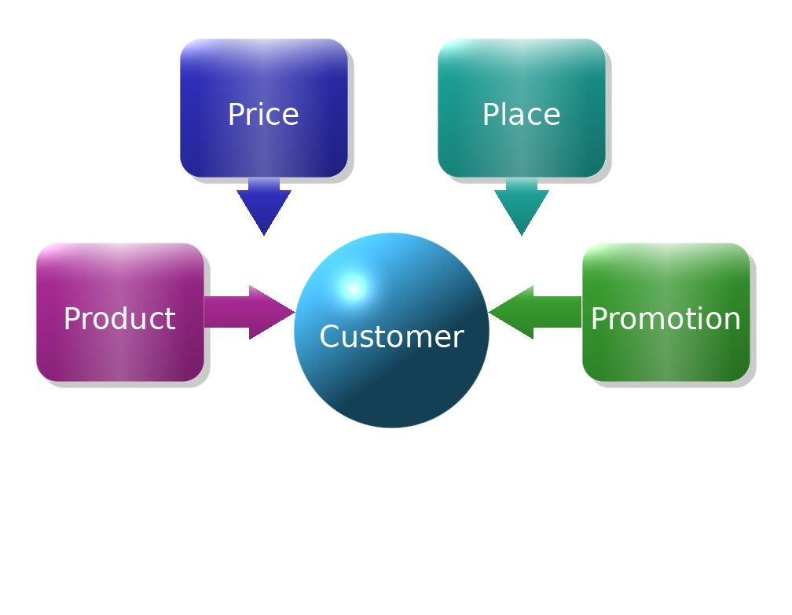
Figure 6.3.1 The customer is at the center of every marketing mix decision. Source: Cadden & Lueder, Small Business Management in the 21st Century (CC BY-NC-SA 3.0)
In marketing, the customer and the consumer are not always the same person. The customer is the one who makes the purchase; the consumer is the one who actually uses the product. A company that orders catering for a staff lunch is the customer; the employees who eat it are the consumers. A parent who buys a toy is the customer; the child who plays with it is the consumer. Understanding this distinction matters because it affects how and to whom you market.
Two Types of Customer Markets
There are two major types of customer markets. Business-to-consumer (B2C) markets consist of individuals buying for themselves, their households, or personal purposes. Business-to-business (B2B) markets consist of organizations, including corporations, small businesses, government agencies, nonprofits, wholesalers, and retailers, purchasing goods and services for their own operations. In terms of total dollar volume, B2B dwarfs B2C. Both markets offer significant opportunities for small businesses.
Consumer Behavior
Consumer behavior describes how individuals select, buy, use, and dispose of goods and services to satisfy their needs and wants. It is the result of a complex interplay of factors that no small business can fully control, but all should understand. These factors fall into four categories:
- Personal factors: Age, gender, race, ethnicity, occupation, income, and life-cycle stage (where a person is in their life journey, such as single, married with children, or retired). A 22-year-old who rents an apartment and lives alone and a 45-year-old who owns a home and has teenagers in the house have fundamentally different purchasing patterns, even for the same product category.
- Social factors: Culture, subculture, social class, family, and reference groups (people and groups whose attitudes and behavior influence an individual’s choices). Family has one of the strongest influences on buying behavior; brand loyalties formed in childhood often persist into adulthood.
- Psychological factors: Motivation, perception (how a person interprets sensory information), learning, attitudes, personality, and self-concept (how we see ourselves and how we want others to see us). These factors explain why two people with identical incomes and demographics may respond very differently to the same product.
- Situational factors: The reason for the purchase, time available, mood, and the physical shopping environment (music, lighting, layout, cleanliness, staff demeanor). A shopper buying a gift behaves differently than the same shopper buying for themselves.
These factors work together to drive a five-stage buying-decision process that applies to most consumer purchases, though the depth and time spent at each stage varies with the nature of the purchase.
Table 6.3.1: The Five Stages of the Consumer Buying Process
| Stage | Name | Description |
|---|---|---|
|
1 |
Problem recognition |
Buyer recognizes a problem or need. |
|
2 |
Information search |
Buyer searches for information depending on the requirements of the situation. Sources may be personal (family or friends), commercial (advertising or websites), public (reviews or media), or experiential (handling the product). |
|
3 |
Evaluation of alternatives |
Buyer compares different brands, services, and retailers based on available information and personal priorities. |
|
4 |
Purchase decision |
Buyer makes a choice based on the evaluation. |
|
5 |
Post-purchase behavior |
How the buyer feels about the purchase afterward, and what actions they take, including reviews, referrals, repeat purchases, or complaints. |
Table 6.3.1 The Five Stages of the Consumer Buying Process. Source: Adapted from Cadden & Lueder, Small Business Management in the 21st Century (CC BY-NC-SA 3.0)
Understanding this process helps small businesses design marketing that reaches customers at the right stage. A business can appear in an information search (strong website, good reviews), influence evaluation of alternatives (clear differentiators, competitive pricing), and encourage positive post-purchase behavior (follow-up, loyalty programs, easy returns), all by understanding the journey the customer takes.
Business Buying Behavior
B2B purchasing is more complex than individual consumer buying. Decisions typically involve larger dollar amounts, longer timelines, and more than one person. In most B2B organizations, purchasing decisions involve multiple people, each playing a different role in the process. Even in a small business, you may encounter:
- Initiator: The person who identifies the need and requests that something be purchased.
- Gatekeeper: Controls the flow of information to the decision-makers, often the administrative staff member who screens vendor calls.
- User: The person who will use the product or service.
- Purchaser/Buyer: The person who makes the actual transaction.
- Decider: The person who determines which product or supplier to use.
- Approver: The person who authorizes the final decision.
- Influencer: Someone who shapes the decision without necessarily using the product, such as a technical advisor or a department head with relevant expertise.
One person may play multiple roles, particularly in smaller organizations. Understanding who is involved in your B2B customers’ purchasing decisions, and what each person cares about, is essential for effective B2B marketing and sales.
| Key Takeaways |
|---|
|
6.4 Customer Experience and Loyalty
Customer experience refers to a customer’s entire interaction with a business: from the first time they encounter its name online, to the moment they walk through the door, to the follow-up after the sale. Experience is not a single event. It is the accumulated impression created by every touch point: the website, the phone call, the store environment, the product, the staff, the packaging, and what happens if something goes wrong.
For small businesses, customer experience is one of the most powerful competitive advantages available. Large competitors may have bigger budgets and broader reach, but they rarely match the depth of personal connection that a well-run small business can create.
Touch Points and the Customer Journey
Touch points are all the moments of contact between a customer and a business throughout the relationship: a Google review, an Instagram post, a phone inquiry, a storefront visit, a transaction, a follow-up email, a problem resolution. Each touch point contributes to the customer’s overall impression.
In a retail context, touch points include store design and layout, merchandise presentation, lighting, music, cleanliness, signage, staff responsiveness, and checkout experience. In a service context, they include the first phone interaction, the appearance of the office or workspace, the clarity of the estimate or proposal, the quality of the work, and the ease of payment. In an online context, they include website design and speed, ease of navigation, product photography, checkout flow, and delivery confirmation.
Meaningful, memorable, and occasionally surprising experiences influence how customers feel about a business in general and whether they come back, spend more, and tell others. The details that seem minor in isolation (a handwritten thank-you note, a staff member who remembers a customer’s name, a problem resolved quickly and graciously) add up to something of far more value than any single transaction.
The Role of Emotion
According to a PwC survey on customer experience, 32 percent of customers will stop doing business with a brand they love after just one bad experience. The product did not fail. The experience did. Customers will pay more for an experience that is not only functional but emotionally rewarding, and they will walk away from one that is not. Businesses that understand this invest in designing experiences that are useful, usable, and enjoyable, not just adequate.
Small businesses have a natural emotional advantage. Because of their size, it is easier to have genuine relationships with customers, create a personal environment, and respond to individual needs in ways that feel human rather than transactional. This emotional connection is what generates the most durable loyalty.
Customer Experience in B2B Markets
Customer experience is relevant in B2B environments too, though it operates differently. B2B purchasing is typically structured, and the relationship unfolds over multiple touch points after the sale: the inquiry process, the proposal, delivery, invoicing, ongoing service, and support, all shaping how a business customer feels about a supplier and whether they continue the relationship.
B2B businesses often serve a smaller number of customers than in B2C, which makes it both possible and worth the investment to know each customer personally. Smart B2B businesses tailor their service to the specific preferences and processes of their individual accounts.
Customer Loyalty
Customer loyalty involves an emotional commitment to a brand or business, a positive attitude toward it, and a behavioral pattern of continued purchasing. All three elements matter. Repeat purchases alone do not always indicate genuine loyalty; a customer who keeps buying from you only because you are the most convenient option may leave as soon as a better alternative appears. Loyalty built on emotional commitment and genuine preference is far more durable.
The benefits of loyal customers to a small business are substantial:
- Loyal customers buy more frequently and are often willing to pay more, creating steadier cash flow.
- They refer other customers, reducing the marketing cost of acquiring new ones.
- They are more forgiving when mistakes happen, especially when the business responds quickly and well.
- Their endorsements, in person and online, often outperform paid advertising in credibility and impact.
- Keeping an existing customer costs significantly less than acquiring a new one, and loyal customers tend to spend more over time, making customer retention one of the highest-return investments a small business can make.
Loyalty begins with the customer experience and is built over time through repeated positive interactions. It cannot be manufactured through loyalty card programs alone. It is earned through consistent quality, genuine responsiveness, and the sense, real or created, that the business actually cares about the people it serves.
| Think about it |
|---|
|
Think about a small business in Las Vegas that you visit regularly: a restaurant, a salon, a coffee shop, a gym, or any other local business. What keeps you coming back? Is it convenience, habit, price, or something more? What specific things does the business do that make you feel valued as a customer? What would it take for you to switch to a competitor? |
| Key Takeaways |
|---|
|
6.5 Digital Marketing for Small Business
Digital marketing has fundamentally changed what is possible for small businesses. Tools and channels that once required large budgets and specialist agencies are now accessible to a single-person operation with a smartphone and a few hours a week. At the same time, the digital environment is more competitive and more crowded than ever, which means that presence alone is not enough. Small businesses that use digital marketing effectively combine the right tools with a clear strategy and consistent execution.
Digital marketing also has a direct impact on cash flow. A product or service that does not reach the right audience will not sell, regardless of its quality. Marketing decisions, including which channels to invest in, how to price for digital markets, and how to structure promotions, are among the most consequential financial decisions a small business makes.
Your Google Business Profile
For most local small businesses, a Google Business Profile (formerly Google My Business) is the single highest-return digital marketing tool available. It is free, and it directly influences what potential customers see when they search for your business or businesses like yours on Google and Google Maps. A complete, accurate, and actively managed profile, with current hours, photos, a description of services, and responses to customer reviews, makes a measurable difference in how often a business appears in local search results and how favorably it is perceived.
Reviews on your Google Business Profile are particularly important. Positive reviews build credibility with prospective customers and signal to Google’s algorithm that your business is legitimate and active. Responding to reviews, both positive and negative, professionally and promptly, demonstrates that you are engaged with your customers and take feedback seriously.
Social Media
Social media platforms give small businesses direct access to current and potential customers at low cost. The key is choosing the right platforms for your specific audience and business type rather than trying to be everywhere at once.
Instagram and TikTok favor visually driven content and work well for food, retail, beauty, fitness, and other businesses where the product or experience is inherently visual. Facebook remains valuable for reaching local audiences, particularly through community groups, event promotion, and paid advertising targeted by geography and demographics. LinkedIn is the primary platform for B2B businesses seeking to connect with professional decision-makers. Pinterest drives traffic for businesses in design, food, fashion, and home-related categories.
Effective social media marketing for small businesses is consistent, authentic, and community-oriented. Posting regularly, even two or three times per week, is more effective than sporadic bursts of activity. Content that shows the people, process, and personality behind the business tends to perform better than purely promotional posts. Engaging with comments and messages builds the sense of relationship that drives loyalty.
Email Marketing
Email marketing remains one of the highest-return digital channels for small businesses, particularly for maintaining relationships with existing customers. An email list is an owned asset, unlike a social media following, it is not subject to algorithm changes or platform decisions. Platforms like Mailchimp and Constant Contact allow even very small businesses to create professional email campaigns, automate follow-up sequences, and track open and click rates.
Effective email marketing for small businesses focuses on value for the reader: useful information, genuine offers, advance notice of events or promotions, and the occasional personal note from the owner. High-frequency promotional emails with no other content tend to generate unsubscribes. Emails that feel like a message from someone who knows the customer tend to generate loyalty.
Online Reviews and Reputation Management
Online reviews on Google, Yelp, TripAdvisor, and industry-specific platforms have become a primary input in consumer purchasing decisions. For Las Vegas businesses, where tourists make up a significant portion of the customer base and rely heavily on reviews before trying an unfamiliar restaurant, attraction, or service, this is especially true.
Managing your online reputation means actively encouraging satisfied customers to leave reviews, responding professionally to negative ones, and monitoring what is being said about your business across platforms. A pattern of genuine positive reviews signals trust. A well-handled negative review, one where the owner acknowledges the issue and describes how it was resolved, can actually strengthen credibility with prospective customers who see that the business takes feedback seriously.
Websites and SEO
A business’s website is its digital storefront, often the first place a potential customer goes to verify that the business is legitimate, understand what it offers, find contact information, and decide whether to make a purchase or inquiry. A website that is slow to load, difficult to navigate on a mobile device, or visually outdated sends a signal about the business before a customer has experienced anything else.
Search engine optimization (SEO) is the practice of structuring a website so that it appears higher in search engine results for relevant queries. For local small businesses, the most important SEO factors are keeping the Google Business Profile current, ensuring the website loads quickly on mobile devices, using clear and specific language about what the business offers and where it operates, and building visibility through mentions and links from other local businesses, community organizations, and industry websites, which signal to search engines that the business is established and trustworthy. SEO is a long-term investment. Results build over time, but for businesses in competitive markets, it is often the difference between being found and being invisible.
Paid Digital Advertising
Paid digital advertising, including Google Ads and Meta (Facebook and Instagram) ads, allows small businesses to reach specific audiences quickly. Unlike traditional advertising, digital ads can be targeted by geography, demographics, interests, and behaviors, and the results are measurable. A small Las Vegas restaurant can run an Instagram ad targeted specifically at users within five miles who have shown interest in dining out, and track exactly how many people clicked through to make a reservation.
The tradeoff is cost: paid advertising requires ongoing investment to sustain results, and the return depends heavily on how compelling the actual ad is (the image, headline, and wording), how precisely it reaches the right audience, and whether the page a customer lands on after clicking makes it easy to take the next step. Small businesses should approach paid advertising with clear goals, realistic budgets, and a willingness to test and adjust rather than expecting immediate returns.
| Key Takeaways |
|---|
|
Watch and reflect
| ► Watch: How Google Business Profile Helped Henna Arts Grow |
|---|
|
► Watch: How Google Business Profile Helped Henna Arts Grow Source: Google for Small Business, YouTube YouTube Clickable Link(opens in new window) Length: (2:24)Nisha came to the United States in 2001 with her daughter and her husband and no professional plans. She started doing henna for friends, who encouraged her to turn it into a business. Twenty years later, Henna Arts is a thriving operation built on craft, community, and customer trust. In this short video, Nisha describes how a Google Business Profile helped her reach new clients, build credibility through photos and reviews, and streamline her booking process. The video is produced by Google, which offers Google Business Profile as a free tool for small businesses. After watching, consider the following:
|
Check Your Understanding
Use the following questions to test your comprehension of this chapter.
- The chapter opens with the observation that every small business is a marketing organization, whether it thinks of it that way or not. Do you agree? Think of a small Las Vegas business that seems to do very little intentional marketing. How would you describe the marketing mix it uses, even unconsciously?
- The marketing concept holds that all business operations should be focused on meeting customer needs. The societal marketing concept adds long-term social and environmental responsibility. Do you think these two ideas are compatible, or does caring about society inevitably come at a cost to the business? Can you think of a Las Vegas business that does both well?
- Think about a recent purchase you made that required meaningful consideration, not an impulse buy, but something you thought about. Walk through the five-stage consumer buying process for that purchase. Which stage took the most time? What information sources influenced your decision most?
- A small Henderson catering company has been operating for three years primarily through word-of-mouth referrals. Business has been steady but not growing. The owner is considering investing in digital marketing for the first time. Which two or three digital channels from this chapter would you recommend she start with, and why? What would you tell her to avoid?
- The chapter distinguishes between customer loyalty built on convenience and loyalty built on emotional commitment. What does the difference look like in practice? How can a small business owner actively build emotional loyalty rather than just convenience loyalty?
Key Terms
B2B (business-to-business) — A market in which businesses sell products or services to other businesses, organizations, or government agencies rather than to individual consumers.
B2C (business-to-consumer) — A market in which businesses sell products or services directly to individual consumers for personal or household use.
Channel pricing — Charging different prices for the same product depending on where or through whom the customer purchases it.
Consumer — The person who actually uses a product or service. The consumer and the customer are not always the same; a parent who buys a toy is the customer, while the child who plays with it is the consumer.
Consumer behavior — How individuals, groups, and organizations select, buy, use, and dispose of goods, services, ideas, or experiences to satisfy their needs and wants.
Customer — The person or business that actually purchases a product or service.
Customer experience — A customer’s entire interaction with a business, from first contact through post-purchase follow-up.
Customer loyalty — An emotional commitment to a brand or business combined with a positive attitude and a pattern of continued purchase behavior.
Customer segment pricing — Charging different prices to different groups of customers for the same product or service.
Customer value — The difference between the perceived benefits a customer receives from a product or service and the perceived costs of obtaining it.
Differentiation — A company’s efforts to set its product or service apart from the competition in ways that matter to customers.
Holistic marketing concept — The view that a business markets itself through everything it does, including products, culture, values, customer service, and community reputation, not just through promotional activities.
Market segmentation — The process of dividing a total market into relatively similar subgroups that behave differently from each other, to focus marketing efforts more effectively.
Marketing — The activity, institutions, and processes for creating, communicating, and exchanging offerings that have value for customers, clients, partners, and society.
Marketing concept — The principle that all business operations should be focused on meeting customer needs and wants in ways that differentiate the company and achieve profitability.
Marketing environment — All forces that affect a business’s ability to operate and market effectively, including internal factors (controllable) and external factors (not controllable).
Marketing management — The day-to-day tactical decisions, resource allocations, and implementation tasks that execute the marketing strategy.
Marketing mix — The combination of product, price, promotion, and place (distribution) that a business uses to reach its target market. Also known as the four Ps.
Marketing strategy — The selection of target markets, differentiation and positioning decisions, and marketing mix choices designed to achieve marketing objectives.
Niche market — A small, narrowly defined market segment that is not being well served by mainstream competitors.
Positioning — Placing a brand in the customer’s mind in relation to competing alternatives, based on attributes and benefits that matter to the customer.
SEO (search engine optimization) — The practice of structuring a website and online presence to appear higher in search engine results for relevant queries.
Societal marketing concept — An extension of the marketing concept that requires businesses to balance customer satisfaction, company profitability, and the long-term well-being of society.
Target market — One or more market segments selected as the primary focus for a business’s marketing and sales efforts.
Touch points — All the communication, human, and physical interactions a customer experiences during their relationship with a business.
Word-of-mouth communication — Customers talking to each other about their experiences with a business, product, or service. Considered the most powerful form of promotion because it comes from people with no commercial interest.
References
American Marketing Association. (n.d.). Definitions of marketing.
Cadden, D. & Lueder, S. (2012). Small business management in the 21st century. LibreTexts-Saylor Foundation. (Licensed CC BY-NC-SA 3.0)
Google. (n.d.). Google Business Profile.
PwC. (2018). Experience is everything: Here’s how to get it right.
This chapter adapts material from Cadden & Lueder, Small Business Management in the 21st Century (LibreTexts/Saylor Foundation, 2012, CC BY-NC-SA 3.0). Section 6.5 (Digital Marketing) is original content incorporating current industry practice. Content development assisted by Claude (Anthropic). Adapted for MGT 103, College of Southern Nevada, by Dr. Mary Ann Hughes Butts.