

13.19: Store Layout Designs
- Page ID
- 75794
\( \newcommand{\vecs}[1]{\overset { \scriptstyle \rightharpoonup} {\mathbf{#1}} } \)
\( \newcommand{\vecd}[1]{\overset{-\!-\!\rightharpoonup}{\vphantom{a}\smash {#1}}} \)
\( \newcommand{\id}{\mathrm{id}}\) \( \newcommand{\Span}{\mathrm{span}}\)
( \newcommand{\kernel}{\mathrm{null}\,}\) \( \newcommand{\range}{\mathrm{range}\,}\)
\( \newcommand{\RealPart}{\mathrm{Re}}\) \( \newcommand{\ImaginaryPart}{\mathrm{Im}}\)
\( \newcommand{\Argument}{\mathrm{Arg}}\) \( \newcommand{\norm}[1]{\| #1 \|}\)
\( \newcommand{\inner}[2]{\langle #1, #2 \rangle}\)
\( \newcommand{\Span}{\mathrm{span}}\)
\( \newcommand{\id}{\mathrm{id}}\)
\( \newcommand{\Span}{\mathrm{span}}\)
\( \newcommand{\kernel}{\mathrm{null}\,}\)
\( \newcommand{\range}{\mathrm{range}\,}\)
\( \newcommand{\RealPart}{\mathrm{Re}}\)
\( \newcommand{\ImaginaryPart}{\mathrm{Im}}\)
\( \newcommand{\Argument}{\mathrm{Arg}}\)
\( \newcommand{\norm}[1]{\| #1 \|}\)
\( \newcommand{\inner}[2]{\langle #1, #2 \rangle}\)
\( \newcommand{\Span}{\mathrm{span}}\) \( \newcommand{\AA}{\unicode[.8,0]{x212B}}\)
\( \newcommand{\vectorA}[1]{\vec{#1}} % arrow\)
\( \newcommand{\vectorAt}[1]{\vec{\text{#1}}} % arrow\)
\( \newcommand{\vectorB}[1]{\overset { \scriptstyle \rightharpoonup} {\mathbf{#1}} } \)
\( \newcommand{\vectorC}[1]{\textbf{#1}} \)
\( \newcommand{\vectorD}[1]{\overrightarrow{#1}} \)
\( \newcommand{\vectorDt}[1]{\overrightarrow{\text{#1}}} \)
\( \newcommand{\vectE}[1]{\overset{-\!-\!\rightharpoonup}{\vphantom{a}\smash{\mathbf {#1}}}} \)
\( \newcommand{\vecs}[1]{\overset { \scriptstyle \rightharpoonup} {\mathbf{#1}} } \)
\( \newcommand{\vecd}[1]{\overset{-\!-\!\rightharpoonup}{\vphantom{a}\smash {#1}}} \)
- Compare and contrast various store layout designs
Each store layout has its pros and cons, and each layout provides a retailer with some ways to influence traffic flow. Here we’ll look at a couple of different layouts, what the pros and cons are for shoppers who are experiencing this type of layout, and some ways that retailers can maximize their sales conversions.
Grid Layout
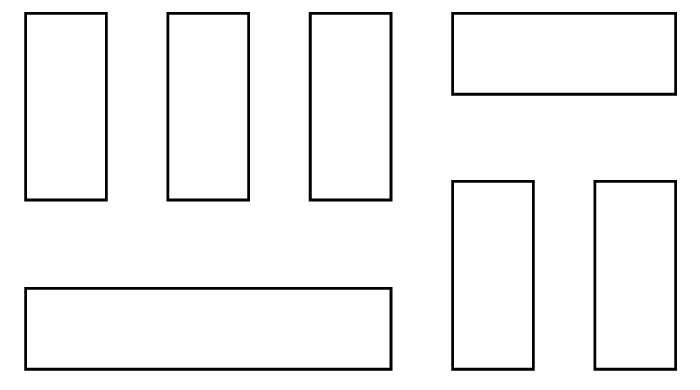 The grid layout is the most common store layout you’re going to find in retail. Used in supermarkets, drug stores, and many big box retail stores, it’s used when stores carry a lot of products (particularly different kinds of products), or when a retail location needs to maximize space.
Pros of the grid layout
- It’s easy to categorize products
- Shoppers are used to the grid layout style and shop it easily
Cons of the grid layout
- It’s boring, and it’s difficult to use this layout to create a “shopping experience” for the customer
- Customers often can’t take shortcuts to what they need
- Line of sight is limited, forcing a customer to look up and down aisles
- Visual “breaks” are needed to keep shoppers engaged
That said, the grid format is so common in retail that it’s been well studied and retailers know how to leverage it to increase sales conversion. Here are some ways they do that:
- Well-placed promotions. Eye level and a little to the left, in fact. If you’re walking through a grid format store counterclockwise, you’re going to notice that which is a little ahead of you. On a turn, that means the promotion will be at eye level and a little off to your left, where you’re looking as you walk. Things don’t get noticed in corners.
- Power walls. Because you can leverage your wall space so well in a grid format store, you can take advantage of this to build power walls. Power walls allow you to display merchandise to draw shoppers into an area they might otherwise skip over in normal traffic patterns. Retailers use repetition by putting a lot of a particular product on the wall, perhaps in different colors or sizes. Check out this great one-minute video about power walls.
- End caps and visual displays. Aisle fixtures have to end, and usually the ends of those aisles are prime real estate to put up a product display. We’ll learn more about these in the next section, but suffice it to say, you have more opportunities to leverage the ends of those aisles with displays and signage in this format than any other.
Racetrack or Loop Layouts
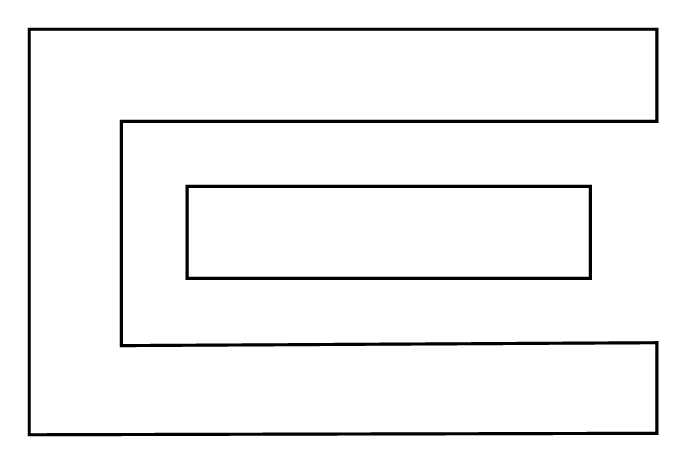 If you’re selling a product that people want to browse, touch and look at, then the racetrack, or loop, layout is one to consider. Customers follow a prescribed path through the merchandise and experience it the way the retailer wants it to be seen.
Pros of the racetrack layout
- Retailers can provide a great “shopping experience” using this layout
- Promotions are easier to execute, because the layout really controls what the shopper sees
- Encourages browsing
Cons of the racetrack layout
- Customers who want to run in and pick up something quickly are often discouraged when faced with this layout
- Not a good layout for a high-turnover store, like a pharmacy or a convenience store
In this kind of layout, the retailer doesn’t really need to influence traffic flow, because traffic can really only move one way. This is what makes the layout so perfect for executing promotions. The retailer knows where the shopper is going to look next, and promotions are arranged accordingly – eye level and a little to the right.
Mixed, or Free Flow, Layout
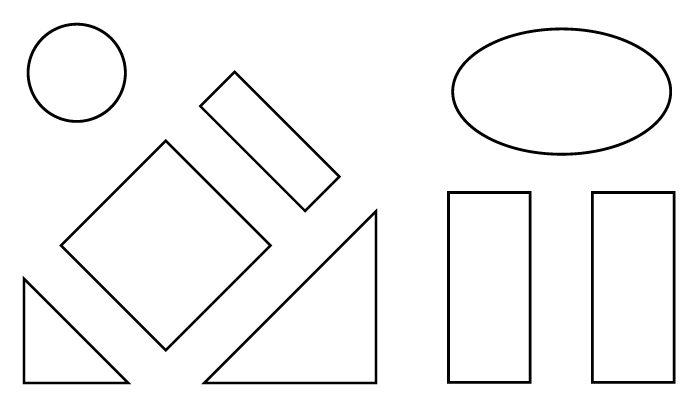 This layout can be anything the retailer wants it to be, in any shape or place. Customer behavior is the only consistent aspect of this kind of layout: we know they will enter and turn right, we know that they won’t want to go up or down a floor and that they won’t shop in too narrow an aisle.
Pros of the mixed layout
- Ideal for a store offering smaller amounts of merchandise
- Easy to create a shopping experience in this layout
Cons of the mixed layout
- Less space to display product
- Easier to confuse the customer
Traffic flow can easily be disrupted if there isn’t some logic to how items are displayed in the store, and if that logic doesn’t exist, it’ll create shopper confusion. Confused shoppers exit the store nearly immediately and usually without purchasing anything.
Retailers can control traffic flow by placing promotions and visual displays as “speed bumps” can entice the shopper from one merchandise “lily pad” to the next. Power walls can be created in this format to attract the shopper as he or she moves along the store. If customers are missing a part of the store, retailers can alter traffic flow by altering the fixtures within to create a new path.
Contributors and Attributions
- Store Layout Designs. Authored by: Freedom Learning Group. Provided by: Lumen Learning. License: CC BY: Attribution