

12.8: Markdown Optimization Software
- Page ID
- 75756
\( \newcommand{\vecs}[1]{\overset { \scriptstyle \rightharpoonup} {\mathbf{#1}} } \)
\( \newcommand{\vecd}[1]{\overset{-\!-\!\rightharpoonup}{\vphantom{a}\smash {#1}}} \)
\( \newcommand{\id}{\mathrm{id}}\) \( \newcommand{\Span}{\mathrm{span}}\)
( \newcommand{\kernel}{\mathrm{null}\,}\) \( \newcommand{\range}{\mathrm{range}\,}\)
\( \newcommand{\RealPart}{\mathrm{Re}}\) \( \newcommand{\ImaginaryPart}{\mathrm{Im}}\)
\( \newcommand{\Argument}{\mathrm{Arg}}\) \( \newcommand{\norm}[1]{\| #1 \|}\)
\( \newcommand{\inner}[2]{\langle #1, #2 \rangle}\)
\( \newcommand{\Span}{\mathrm{span}}\)
\( \newcommand{\id}{\mathrm{id}}\)
\( \newcommand{\Span}{\mathrm{span}}\)
\( \newcommand{\kernel}{\mathrm{null}\,}\)
\( \newcommand{\range}{\mathrm{range}\,}\)
\( \newcommand{\RealPart}{\mathrm{Re}}\)
\( \newcommand{\ImaginaryPart}{\mathrm{Im}}\)
\( \newcommand{\Argument}{\mathrm{Arg}}\)
\( \newcommand{\norm}[1]{\| #1 \|}\)
\( \newcommand{\inner}[2]{\langle #1, #2 \rangle}\)
\( \newcommand{\Span}{\mathrm{span}}\) \( \newcommand{\AA}{\unicode[.8,0]{x212B}}\)
\( \newcommand{\vectorA}[1]{\vec{#1}} % arrow\)
\( \newcommand{\vectorAt}[1]{\vec{\text{#1}}} % arrow\)
\( \newcommand{\vectorB}[1]{\overset { \scriptstyle \rightharpoonup} {\mathbf{#1}} } \)
\( \newcommand{\vectorC}[1]{\textbf{#1}} \)
\( \newcommand{\vectorD}[1]{\overrightarrow{#1}} \)
\( \newcommand{\vectorDt}[1]{\overrightarrow{\text{#1}}} \)
\( \newcommand{\vectE}[1]{\overset{-\!-\!\rightharpoonup}{\vphantom{a}\smash{\mathbf {#1}}}} \)
\( \newcommand{\vecs}[1]{\overset { \scriptstyle \rightharpoonup} {\mathbf{#1}} } \)
\( \newcommand{\vecd}[1]{\overset{-\!-\!\rightharpoonup}{\vphantom{a}\smash {#1}}} \)
Learning Objectives
- Understand the three types of price adjustments used by retailers
A price adjustment is any change to the original price of a product in a retailer’s inventory. There are three primary forms of price adjustment: promotion, price protection and markdown. One caveat: different retailers use different terminology and even accounting methods in this area. We will discuss retail price adjustments in their most commonly-used context.
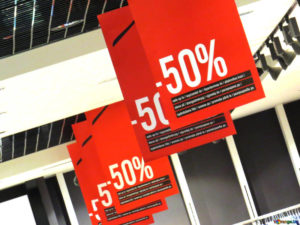 A promotion is a temporary form of price adjustment. This is when a product is “on sale” for a designated time period and will return back to its original or “regular” price after the promotion ends. Retailers like to be able to show a value in the sale, so a comparison between the regular price and the promotional price is thought to stimulate more unit sales. There are regulations, usually enacted by state, as to how a “regular” price is established- usually it is based on how long a product has been in inventory at a certain price. The retailer must be cognizant of this when planning promotions and must limit the amount of time the product is “on sale” or else the promotional price will become the new “regular price.”
Price protection is a common form of price adjustment and the one that probably comes to mind first for the consumer. What happens when a shopper purchases a product on Sunday only to see it advertised at a lower price on Monday? Most retailers offer “price protection” for a time period before and after a product has been reduced in price by a promotion. Most retailers will offer to refund the difference in price for 10- 30 days after purchase.
Another form of price protection is “price matching”. This is closely related to the concept of competition-oriented pricing discussed earlier in this module. Price matching is the price adjustment made by a retailer when the same product purchased is advertised or available in the competition for a lower price. Retailers will usually refund the price difference, although in fiercely competitive situations, they have been known to offer 5% or 10% additionally on top of the difference in price.
Finally, a markdown is a permanent form of price adjustment used by the retailer to “liquidate” the inventory of a product or category of product. There are many different approaches to how retailers manage this form of price adjustment. Some retailers have an internal policy that establishes how much the first markdown must be. Depending on the retailer or the product category, first markdowns can range from 20% off to 50% or even 60% off the original price.
Also, retailers may have a set schedule of when subsequent markdowns are taken to ensure that the inventory will be eliminated by a target date. For example, an item marked down to 40% off could then see an additional price adjustment in four weeks, with an additional 30% off being applied to its price. Two weeks later a retailer could slash further and take another 20% off that price. The markdown process can be manually managed (monitor sales based on the latest price adjustment and calculate weeks of supply) or automated using a variety of software applications available to retailers.
Practice Questions
Contributors and Attributions
- Markdown Optimization Software. Authored by: Bob Danielson. Provided by: Lumen Learning. License: CC BY: Attribution
- Grand Sale. Authored by: torange.biz. Located at: https://torange.biz/grand-sale-16260. License: CC BY: Attribution