

13.2: Employment At Will
- Page ID
- 42063

\( \newcommand{\vecs}[1]{\overset { \scriptstyle \rightharpoonup} {\mathbf{#1}} } \)
\( \newcommand{\vecd}[1]{\overset{-\!-\!\rightharpoonup}{\vphantom{a}\smash {#1}}} \)
\( \newcommand{\dsum}{\displaystyle\sum\limits} \)
\( \newcommand{\dint}{\displaystyle\int\limits} \)
\( \newcommand{\dlim}{\displaystyle\lim\limits} \)
\( \newcommand{\id}{\mathrm{id}}\) \( \newcommand{\Span}{\mathrm{span}}\)
( \newcommand{\kernel}{\mathrm{null}\,}\) \( \newcommand{\range}{\mathrm{range}\,}\)
\( \newcommand{\RealPart}{\mathrm{Re}}\) \( \newcommand{\ImaginaryPart}{\mathrm{Im}}\)
\( \newcommand{\Argument}{\mathrm{Arg}}\) \( \newcommand{\norm}[1]{\| #1 \|}\)
\( \newcommand{\inner}[2]{\langle #1, #2 \rangle}\)
\( \newcommand{\Span}{\mathrm{span}}\)
\( \newcommand{\id}{\mathrm{id}}\)
\( \newcommand{\Span}{\mathrm{span}}\)
\( \newcommand{\kernel}{\mathrm{null}\,}\)
\( \newcommand{\range}{\mathrm{range}\,}\)
\( \newcommand{\RealPart}{\mathrm{Re}}\)
\( \newcommand{\ImaginaryPart}{\mathrm{Im}}\)
\( \newcommand{\Argument}{\mathrm{Arg}}\)
\( \newcommand{\norm}[1]{\| #1 \|}\)
\( \newcommand{\inner}[2]{\langle #1, #2 \rangle}\)
\( \newcommand{\Span}{\mathrm{span}}\) \( \newcommand{\AA}{\unicode[.8,0]{x212B}}\)
\( \newcommand{\vectorA}[1]{\vec{#1}} % arrow\)
\( \newcommand{\vectorAt}[1]{\vec{\text{#1}}} % arrow\)
\( \newcommand{\vectorB}[1]{\overset { \scriptstyle \rightharpoonup} {\mathbf{#1}} } \)
\( \newcommand{\vectorC}[1]{\textbf{#1}} \)
\( \newcommand{\vectorD}[1]{\overrightarrow{#1}} \)
\( \newcommand{\vectorDt}[1]{\overrightarrow{\text{#1}}} \)
\( \newcommand{\vectE}[1]{\overset{-\!-\!\rightharpoonup}{\vphantom{a}\smash{\mathbf {#1}}}} \)
\( \newcommand{\vecs}[1]{\overset { \scriptstyle \rightharpoonup} {\mathbf{#1}} } \)
\(\newcommand{\longvect}{\overrightarrow}\)
\( \newcommand{\vecd}[1]{\overset{-\!-\!\rightharpoonup}{\vphantom{a}\smash {#1}}} \)
\(\newcommand{\avec}{\mathbf a}\) \(\newcommand{\bvec}{\mathbf b}\) \(\newcommand{\cvec}{\mathbf c}\) \(\newcommand{\dvec}{\mathbf d}\) \(\newcommand{\dtil}{\widetilde{\mathbf d}}\) \(\newcommand{\evec}{\mathbf e}\) \(\newcommand{\fvec}{\mathbf f}\) \(\newcommand{\nvec}{\mathbf n}\) \(\newcommand{\pvec}{\mathbf p}\) \(\newcommand{\qvec}{\mathbf q}\) \(\newcommand{\svec}{\mathbf s}\) \(\newcommand{\tvec}{\mathbf t}\) \(\newcommand{\uvec}{\mathbf u}\) \(\newcommand{\vvec}{\mathbf v}\) \(\newcommand{\wvec}{\mathbf w}\) \(\newcommand{\xvec}{\mathbf x}\) \(\newcommand{\yvec}{\mathbf y}\) \(\newcommand{\zvec}{\mathbf z}\) \(\newcommand{\rvec}{\mathbf r}\) \(\newcommand{\mvec}{\mathbf m}\) \(\newcommand{\zerovec}{\mathbf 0}\) \(\newcommand{\onevec}{\mathbf 1}\) \(\newcommand{\real}{\mathbb R}\) \(\newcommand{\twovec}[2]{\left[\begin{array}{r}#1 \\ #2 \end{array}\right]}\) \(\newcommand{\ctwovec}[2]{\left[\begin{array}{c}#1 \\ #2 \end{array}\right]}\) \(\newcommand{\threevec}[3]{\left[\begin{array}{r}#1 \\ #2 \\ #3 \end{array}\right]}\) \(\newcommand{\cthreevec}[3]{\left[\begin{array}{c}#1 \\ #2 \\ #3 \end{array}\right]}\) \(\newcommand{\fourvec}[4]{\left[\begin{array}{r}#1 \\ #2 \\ #3 \\ #4 \end{array}\right]}\) \(\newcommand{\cfourvec}[4]{\left[\begin{array}{c}#1 \\ #2 \\ #3 \\ #4 \end{array}\right]}\) \(\newcommand{\fivevec}[5]{\left[\begin{array}{r}#1 \\ #2 \\ #3 \\ #4 \\ #5 \\ \end{array}\right]}\) \(\newcommand{\cfivevec}[5]{\left[\begin{array}{c}#1 \\ #2 \\ #3 \\ #4 \\ #5 \\ \end{array}\right]}\) \(\newcommand{\mattwo}[4]{\left[\begin{array}{rr}#1 \amp #2 \\ #3 \amp #4 \\ \end{array}\right]}\) \(\newcommand{\laspan}[1]{\text{Span}\{#1\}}\) \(\newcommand{\bcal}{\cal B}\) \(\newcommand{\ccal}{\cal C}\) \(\newcommand{\scal}{\cal S}\) \(\newcommand{\wcal}{\cal W}\) \(\newcommand{\ecal}{\cal E}\) \(\newcommand{\coords}[2]{\left\{#1\right\}_{#2}}\) \(\newcommand{\gray}[1]{\color{gray}{#1}}\) \(\newcommand{\lgray}[1]{\color{lightgray}{#1}}\) \(\newcommand{\rank}{\operatorname{rank}}\) \(\newcommand{\row}{\text{Row}}\) \(\newcommand{\col}{\text{Col}}\) \(\renewcommand{\row}{\text{Row}}\) \(\newcommand{\nul}{\text{Nul}}\) \(\newcommand{\var}{\text{Var}}\) \(\newcommand{\corr}{\text{corr}}\) \(\newcommand{\len}[1]{\left|#1\right|}\) \(\newcommand{\bbar}{\overline{\bvec}}\) \(\newcommand{\bhat}{\widehat{\bvec}}\) \(\newcommand{\bperp}{\bvec^\perp}\) \(\newcommand{\xhat}{\widehat{\xvec}}\) \(\newcommand{\vhat}{\widehat{\vvec}}\) \(\newcommand{\uhat}{\widehat{\uvec}}\) \(\newcommand{\what}{\widehat{\wvec}}\) \(\newcommand{\Sighat}{\widehat{\Sigma}}\) \(\newcommand{\lt}{<}\) \(\newcommand{\gt}{>}\) \(\newcommand{\amp}{&}\) \(\definecolor{fillinmathshade}{gray}{0.9}\)In general, employees are free to quit a job at any time for any reason, with or without notice. Similarly, employers are free to end a worker’s employment at any time for any reason, with or without notice. This principle is called employment at will. This doctrine is based on the concept that employment is a form of an implied contractual relationship. Therefore, as long as both parties want to continue their contract to work together, the law presumes they will. When one party does not want to continue, then they may end their working relationship.
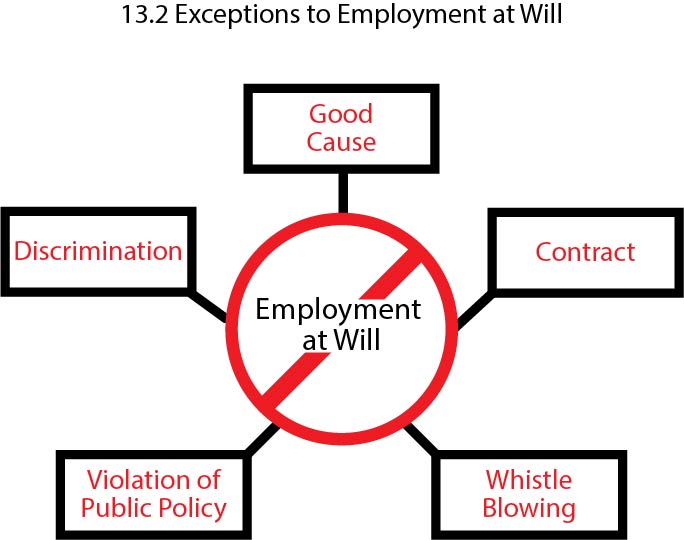
There are five major exceptions to the employment at will doctrine:
- Contract;
- Good cause;
- Discrimination against an employee based on membership in a protected class;
- Violation of public policy; and
- Whistleblowing.
Contract
Employers and employees may modify the employment at will doctrine through contract. In addition to formal, written employment contracts, courts have also enforced oral promises made during the hiring process. Promises made to job applicants are generally enforceable, even when the promises are not approved by the employer’s executives or upper management. Therefore, it is important when hiring employees that companies do not make promises that can be reasonably interpreted to be guaranteed employment or employment for a certain period of time.
Employee handbooks also may create implied contracts that modify the employment at will doctrine. Often handbooks state that the company follows a progressive discipline policy and that employees may only be fired for “just cause” or after receiving warnings, notice, hearing, or other procedures. Policies such as this create an implied contract that require businesses to follow the progressive discipline policy before terminating a worker’s employment, in absence of good cause.
Good Cause
The definition of “good cause” for terminating the employment of a worker varies from state to state. And businesses often define “good cause” in their policies. However, most states recognize the following as good cause to fire an employee without going through progressive discipline first:
- Theft;
- Fraud;
- Damage to company property;
- Being under the influence of illegal drugs or alcohol at work;
- Fighting;
- Threats against other employees or customers;
- Domestic violence;
- Having weapons on premises;
- Unethical behavior; and
- Willful or malicious misbehavior.
Poor performance also constitutes good cause for firing an employee. Employers need to be careful, however, to document the performance issues and to engage in progressive discipline when appropriate. If an employee has not been counseled that their performance is unsatisfactory, then the employee is more likely to bring a charge of wrongful discharge against the employer. Courts are more likely to rule that poor performance constitutes good cause when an employee has notice of the performance issue(s) and has a reasonable opportunity to fix them.
Discrimination Against a Protected Class Member
Anti-discrimination laws make it illegal to take adverse actions against a member of a protected class based on their membership in the class. A protected class is a group of people who are protected by laws that prohibit discrimination based on a personal characteristic, such as race, color, religion, gender, national origin, age or disability.
As discussed in Chapter 14, adverse actions include failure to hire, failure to promote, demotion, and termination of employment. That is not to say that someone who is a member of a protected class may never be fired. Rather, it is illegal to fire them because of their race, color, religion, gender, national origin, age or disability.
Violation of Public Policy
The public policy exception occurs when an employee is fired for:
- Refusing to perform an action that violates a law or public policy; or
- For exercising a legal right or advancing a public policy.
In other words, an employee can’t be fired for refusing to do something illegal or doing something legal that the employer does not want done. For example, an employee cannot be fired for not falsifying reports, for refusing to testify falsely in court, for filing a workers’ compensation claim, or for serving on a jury.
Whistleblowing
A whistleblower is an employee who reports the employer’s illegal behavior to a governmental or law enforcement agency. Many different laws have whistleblower provisions that encourage people who have knowledge of illegal activity to report it without fear of retribution or losing their jobs. Whistleblower protections apply to good faith reports of wrongdoing, even if it turns out that the activity is not illegal. However, whistleblower protection does not usually protect employees who make reports that they either know, or should have known, do not include illegal activity.