

9.2: Understanding Team Dynamics
- Page ID
- 134878

\( \newcommand{\vecs}[1]{\overset { \scriptstyle \rightharpoonup} {\mathbf{#1}} } \)
\( \newcommand{\vecd}[1]{\overset{-\!-\!\rightharpoonup}{\vphantom{a}\smash {#1}}} \)
\( \newcommand{\dsum}{\displaystyle\sum\limits} \)
\( \newcommand{\dint}{\displaystyle\int\limits} \)
\( \newcommand{\dlim}{\displaystyle\lim\limits} \)
\( \newcommand{\id}{\mathrm{id}}\) \( \newcommand{\Span}{\mathrm{span}}\)
( \newcommand{\kernel}{\mathrm{null}\,}\) \( \newcommand{\range}{\mathrm{range}\,}\)
\( \newcommand{\RealPart}{\mathrm{Re}}\) \( \newcommand{\ImaginaryPart}{\mathrm{Im}}\)
\( \newcommand{\Argument}{\mathrm{Arg}}\) \( \newcommand{\norm}[1]{\| #1 \|}\)
\( \newcommand{\inner}[2]{\langle #1, #2 \rangle}\)
\( \newcommand{\Span}{\mathrm{span}}\)
\( \newcommand{\id}{\mathrm{id}}\)
\( \newcommand{\Span}{\mathrm{span}}\)
\( \newcommand{\kernel}{\mathrm{null}\,}\)
\( \newcommand{\range}{\mathrm{range}\,}\)
\( \newcommand{\RealPart}{\mathrm{Re}}\)
\( \newcommand{\ImaginaryPart}{\mathrm{Im}}\)
\( \newcommand{\Argument}{\mathrm{Arg}}\)
\( \newcommand{\norm}[1]{\| #1 \|}\)
\( \newcommand{\inner}[2]{\langle #1, #2 \rangle}\)
\( \newcommand{\Span}{\mathrm{span}}\) \( \newcommand{\AA}{\unicode[.8,0]{x212B}}\)
\( \newcommand{\vectorA}[1]{\vec{#1}} % arrow\)
\( \newcommand{\vectorAt}[1]{\vec{\text{#1}}} % arrow\)
\( \newcommand{\vectorB}[1]{\overset { \scriptstyle \rightharpoonup} {\mathbf{#1}} } \)
\( \newcommand{\vectorC}[1]{\textbf{#1}} \)
\( \newcommand{\vectorD}[1]{\overrightarrow{#1}} \)
\( \newcommand{\vectorDt}[1]{\overrightarrow{\text{#1}}} \)
\( \newcommand{\vectE}[1]{\overset{-\!-\!\rightharpoonup}{\vphantom{a}\smash{\mathbf {#1}}}} \)
\( \newcommand{\vecs}[1]{\overset { \scriptstyle \rightharpoonup} {\mathbf{#1}} } \)
\(\newcommand{\longvect}{\overrightarrow}\)
\( \newcommand{\vecd}[1]{\overset{-\!-\!\rightharpoonup}{\vphantom{a}\smash {#1}}} \)
\(\newcommand{\ket}[1]{\left| #1 \right>}\)
\(\newcommand{\bra}[1]{\left< #1 \right|}\)
\(\newcommand{\braket}[2]{\left< #1 \vphantom{#2} \right| \left. #2 \vphantom{#1} \right>}\)
\(\newcommand{\braopket}[3]{\left< #1 \vphantom{#2}\vphantom{#3} \right| #2 \vphantom{#1}\vphantom{#3} \left| #3 \vphantom{#1}\vphantom{#2} \right>}\)
\(\newcommand{\qmvec}[1]{\mathbf{\vec{#1}}}\)
\(\newcommand{\op}[1]{\hat{\mathbf{#1}}}\)
\(\newcommand{\expect}[1]{\langle #1 \rangle}\)
\(\newcommand{\dfn}[1]{\emph{\textbf{#1}}}\)
- Develop strong relationships within teams
- Identify best practices of successful teams
What are Team Dynamics?
"Team dynamics" is the term used to describe the interactions and relationships among team members. How well do team members collaborate, communicate, and influence each other? How well do they perform, and how well do they accomplish their goals? Positive team dynamics can lead to better outcomes, including higher productivity and greater employee satisfaction. However, negative team team dynamics can result in conflicts, poor performance, and lower employee satisfaction. Factors that affect team dynamics include:
- Communication: How well team members communicate, including styles and patterns
- Roles and responsibilities: How tasks are divided
- Conflict resolution: How team members address and resolve disagreements
- Trust: How much team members value and respect each other
- Diversity: The varied backgrounds, skills, and perspectives of team members
- Leadership: The style and effectiveness of the team's leader
What Makes a Powerful Team?
A powerful team typically has
Team Members' Roles
Assigning roles helps to clarify individual responsibilities. Expectations are clear--team members know what they should do and what the rest of the team expects from them. Clarifying roles improves communication, decision-making, and cohesion among team members. Although everyone should be responsible for brainstorming and problem solving, most teams should assign these four key roles:
- A Leader: Some experts say that this is the most important role on a team. A leader can keep the team focused, mediate conflicts, and ensure that individuals are held accountable.
- A minute-taker (note taker or scribe): Although technology can handle this task, you'll still need someone to review, correct, and disseminate meeting minutes. You can use videoconferencing platforms such as Zoom, MS Teams, or Google Meet to record the meeting audio, then use AI-powered transcription tools such as Google's NotebookLM or ChatGPT (or those within the conferencing platform) to automatically transcribe the conversation.
- Lessons-learned tracker: Identify one person to track both positive and negative outcomes of meetings and projects. This individual can seek feedback from members and document what went well and why, and what did not go well and why. By assigning this role, teams can avoid repeating mistakes.
- Devil’s advocate: Teams need to embrace conflict and different points of view. A Devil’s advocate is a person who brings up alternatives or objections to others’ ideas. Assigning such a role can make the team more objective and reduce problems such as Groupthink. You might want to rotate this role to give everyone practice in seeing other perspectives.
Successful Teams Build Trust Through Actions
According to Patrick Lencioni in his bestselling book "The 5 Dysfunctions of a Team," dysfunctional teams exhibit absence of trust, fear of conflict, lack of commitment, avoidance of accountability, and inattention to results. Lencioni displays these traits in a triangle, with lack of trust at the bottom because trust is considered the foundational element for a successful team. Teams can develop trust through the following actions:
- Admit mistakes
- Ask for help
- Appreciate and use each other's strengths
- Give the benefit of the doubt
- Offer and accept apologies
- Take risks
- Work together to solve problems
- Develop teambuilding rituals
Team Building Rituals
A ritual is an action that a person or group does repeatedly. Team rituals can create a sense of camaraderie and belonging and strengthen interpersonal relationships. These activities or events can boost morale and lead to a more collaborative, supportive environment. Most importantly, they can make work fun!
Examples of rituals:
- Daily Check-Ins to Build Connection: Spend as little as five minutes to share progress, priorities, or "the best thing that happened [today, yesterday, this week].
- Weekly Focus Meetings to Build Trust and Ensure Progress: Clarify priorities, remove obstacles, share solutions.
- Celebrations of Milestones: Give praise; share success stories, ideas, and insight. Some companies provide incentives (free lunch, additional time off, etc.) for achieving goals.
- Annual Retreats: A yearly offsite retreat allows time for the team to reflect on what to keep doing, what to stop doing, and what to start doing.
Tri Pointe Homes, Inc., builds homes in the U.S. The company established the "Compass Club," a cross-functional team focused on creating an inclusive culture. The Compass Club organizes monthly events around themes such as Random Acts of Kindness Week and National Adoption Month. Employees also participate in activities such as shoe drives, diaper drives, and beach cleanups. These initiatives not only recognize and reward employee efforts but also strengthen teamwork and community involvement. [1]
If you want to go fast, go alone. If you want to go far, go together. -- African proverb
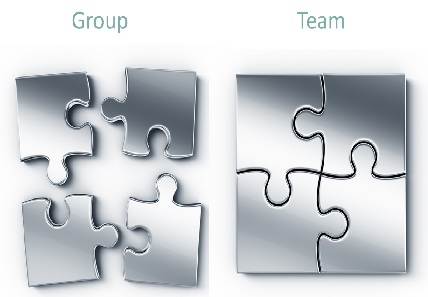
- Figure 9.2.1 : Disconnected Group Versus Connected Team. (CC BY 4.0; Rae Ann Ianniello)
- Teams and Team Dynamics. (CC BY 4.0; Susan Kendall via Lumen Learning)
- Understanding Team Dynamics (CC BY 4.0; Rae Ann Ianniello)
- Common Group Behaviors. (CC BY 4.0; John/Lynn Bruton. via Lumen Learning)
- Managing Groups and Teams/Group Dynamics. (CC BY-SA 4.0; Wikibooks via Wikipedia)
- Figure 9.2.2 : A Team Meeting. (Unsplash License; Annie Spratt via Unsplash)
Footnotes
[1] PEOPLE Staff. "PEOPLE's 100 Companies That Care in 2024: Employers Putting Their Communities First." PEOPLE, August 21, 2024.